In This Issue
President's Message
Featured Platinum Sponsor
In the News
Event Recaps
Upcoming Events
|
|
President's Message
Michael Casolo, JLL
As
I write this message for our first newsletter of the new year, it seems like
the start of 2015 was a long time ago in “CoreNet years.” Since January
1, our chapter has hit the ground running in true award-winning chapter
fashion.
Our
holiday party at Domenico Winery in San Carlos was a smashing success and was
well-attended by a great cross-section of our membership. The January chapter
meeting, our 15th Annual Market Forecast event, was generously
hosted by Electronic Arts and was one of the most engaging and dynamic panels
that we have had in recent years – kudos not only to our panelists (who
included Ken Rosen from the Fisher Center at U.C. Berkeley), but also to our
Programs Committee for another job well done. (In case you missed this
important program, there is a very detailed Market Forecast recap included
below.)
One of our most important orders of business for our Chapter during
this time of the year is succession planning, which has two major components:
officers and directors, and committee co-chairs. Your Board has set as a very
high priority a commitment to a transparent, inclusive and fully representative
succession process. Additionally, we have focused this year on looking two
steps ahead instead of just one. We want to promote and provide leadership
opportunities for our members. As such, we need to look not just at who is in
the candidate pool today today, but also who we can develop to populate the
pool down the road. We then need to proactively provide them with the
experience that they need to be productive Board members.
The first output of this process brought to you our nominated
slate of officers for 2015/2016: President Sandy Heistand (Advent),
EVP/President-Elect Michael Bangs (Oracle), Secretary Jamie Moore (DPR
Construction), Director-at-Large John Lucas (Juniper), and Director-at-Large
Jay Sholl (CBRE). Chris Chandlee (AT&T) will continue into the second year
of his term as treasurer, and Dick Palomba will do the same as our
administrative officer. As the soon-to-be immediate past president, I will step
into the third director-at-large position.
In the coming weeks, we will be selecting our committee
co-chairs -- the group that does the serious work for the Chapter. I
would be delinquent in my duties if I did not take this opportunity to
encourage all of you to become involved and join a committee – and to consider
becoming a Board member down the road. It is a truly rewarding experience.
(Information on how to get more involved can be found at the end of this
newsletter.)
With that I will leave you with my hopes that I will see you
at an upcoming chapter event, whether a monthly program, a Women of CoreNet
event, or a Young Leaders get-together. Here’s to a strong 2015 for CoreNet
NorCal.
Michael Casolo
|
Back to Top
|
|
CoreNet January Chapter Meeting Recap
by Erin Carew, Instigate Marketing & Public Relations
One of the best-attended meetings every year is
our Annual Market Forecast because of the valuable information that is provided
to our members. Even if you could not make it to the meeting this year,
we have provided here a detailed recap of the important discussion, including
some of the most informative presentation slides.
On January 15, 2015, CoreNet Northern California
held its Annual Market Forecast event at Electronic Arts’ headquarters in
Redwood City. Featured speaker Ken Rosen, chairman of Rosen Consulting
Group, a real estate market research firm, and chairman of the Fisher Center
for Real Estate and Urban Economics at U.C. Berkeley, delivered an informative and entertaining
keynote address to a crowd of more than 150.
Rosen began his remarks with a macro perspective
and shared what he sees as the factors affecting the current economic
landscape. On the positive side, he identified private sector job growth,
strong auto sales, very low interest rates, global monetary easing, declining
oil and gas prices (with a possible end of OPEC) and improvement of the
for-sale housing market. He pointed out negative influences as well,
including a recession in Europe, a slowdown in emerging markets such as China,
the “Fragile Five” and Russia, the contagion effect from the oil and commodity
price plunge, geopolitical events such as ISIS in Iraq, Syria and Saudi Arabia,
as well as unrest in Ukraine, Gaza, Pakistan, Iran, North Korea, Libya,
interest rate normalization and the question of a credit and asset bubble.
Rosen noted that while the rest of the country
is experiencing choppy to moderate growth, the Bay Area is currently
experiencing a boom. He indicated that global events could cause us to go
into recession, however, be believes nothing domestic would cause that to occur
in the near future.
Regarding U.S. employment growth, Rosen stated
that we have been through the worst recession of our careers with estimated
loss from peak to trough of 8,818,000 jobs. Since February 2010, approximately
11,215,000 jobs have been created. In 2014, jobs grew at an average of
238,000 per month. “We are creating a jobs machine in the Bay Area,” said
Rosen, “Job openings have soared, and we are at full employment by anyone’s
measure.” He added, “However, Federal Reserve Chairperson Janet
Yellen is yet to reflect this in monetary policy.”
Rosen went on to give his perspective on
monetary policy and shared his predictions about when and how much the Fed will
raise short-term interest rates, often referred to as policy firming. He
criticized the quantitative easing program the Fed initiated in 2013 under
former Chairman Ben Bernanke, which consisted of buying trillions of dollars of
bonds. Rosen dismissed the program, which ended in October of last year,
as ineffective as it created few new jobs, however, it did create the
beginnings of an asset bubble.
Regarding the central bank’s decision to keep
short-term interest rates near zero, Rosen said, “We have never had these
unheard of low rates. There has been nothing like this since the Great
Depression.” He commented on the Fed’s quarterly forecast, which he
referred to as “the dots.” Published by the Federal Open Market
Committee, the forecast details members’ projections for the federal funds
rates, their key short-term policy instruments, which are released in the form
of dot plots. Rosen indicated that currently “the dots” illustrate the
committee forecasts raising short rates gradually ultimately reaching 2-½
percent by December 2015. He said, “This will be a big change from where
we are now but is still low for interest rates.” He pointed out that the
biggest challenge would be rates normalizing and said that he believes much
would take place over the next three years. He added, “Interest rates in
places like Europe and Japan are too low. That’s why our rates are not going
up.” Rosen said he thinks it is likely we will see a “forward curve” with
the ten-year bond going to 3 percent by the end of 2015 and to 4.5 percent by
2019. He commented that we have a trillion dollars less in residential
debt and that he thinks money is too tight, pointing out that even many
well-qualified buyers are unable to qualify for a mortgage.
Rosen commented on inflation and indicated it is
contained for the moment. He said that many experts have expressed
concern that the quantitative easing program would devalue the dollar and drive
up inflation. However the opposite seems to have occurred. Rosen said, “I
think oil and commodity deflation is a good thing. We don’t have to have
wage increases because costs are down.” He added, “I can’t believe what I
hear out of the central bank regarding deflation.”
Another key component to the economic landscape
Rosen addressed is that U.S. oil production has soared. He expressed that
U.S. has begun importing considerably less and has actually started to export
oil. He said, “I think the Saudis are making a huge mistake by refraining
from cutting production.” He added that he believes gas, natural
gas and electricity rates will drop and that it will have a negative effect for
places like Russia, Texas and the Middle East.
Rosen gave an overview of the economic outlook
for 2014-15 and characterized it as moderate to choppy recovery at 65 percent.
In terms of economic growth, he predicts upward movement in GDP of 2.8
percent.
Relative to employment, he forecasts the
unemployment rate decline from the current rate of 5.8 to 5.3 percent during
the next year. He also believes that we will see 1.9 percent growth in
employment with 2.6 million jobs created. He sees the S&P 500 at 2,189 and
the Dow Jones Industrial Average at 18,921. (Please see Rosen’s Economic Outlook 2014-15 slide for a complete overview.)
Here in the Bay Area, Rosen believes we will
continue to be top on the list of regions with strong employment growth and
will experience double the national average. He joked that he has received job
offers that would require him to move to Philadelphia. He said, “They hit
their employment peak in 1790, so I declined.” He commented that he
thinks Washington D.C. is unattractive from a real estate perspective with
government agencies and contractors shrinking. He believes all cities
with a strong tech presence will remain on near the top of the list in 2015 in
terms of growth, and cities with a concentration of energy companies place high
as well. However cities with heavy energy employment will be at the
bottom of the list next year.
He went over midpoint pricing by property sector
and provided average cap rates and IRRs and compared today’s averages to those
experienced at the peak in 2007. For gateway office product, he showed
2007 cap rates of 5.25 percent and IRRs of 7.40 percent compared to 2014 cap
rates at 5.00 percent and IRRs at 6.25 percent. For suburban office, he
showed 2007 cap rates at 6.25 percent and IRRs at 8.40 percent and 2014 cap
rates at 6.50 percent and IRRs at 7.50 percent. For gateway industrial
product, he showed 2007 cap rates at 5.15 percent and IRRs at 7.25 percent and
2014 cap rates at 5.00 percent and IRRs at 6.25 percent. (Please see the slides titled Midpoint Pricing by Property Sector for a complete overview).
In terms of where we are in the cycle in San Francisco,
Rosen opined that multifamily is furthest along. The office market shows
more building; however, it is relatively tame in terms of new construction.
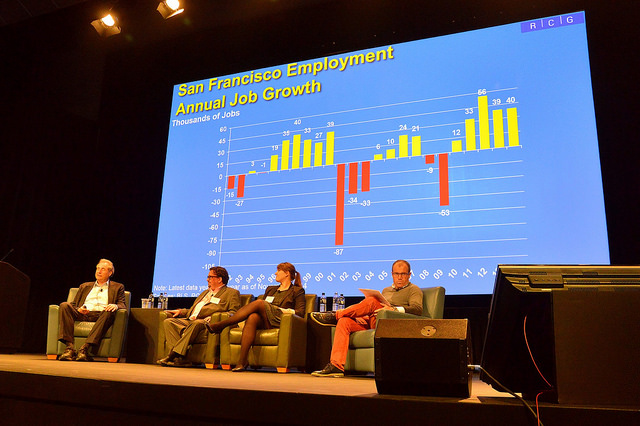
Vacancy rates are, of course, down and rents are up. 40,000 jobs
were created in the city in 2014, and there is a good number of new office
buildings under construction. He believes Silicon Valley has more staying
power than in past cycles and a little toppiness in stocks is unlikely to cause
a collapse. He pointed out that a great deal more office space is being
built, vacancy rates are down, and rents are up. He indicated San
Francisco would bump up against Prop M soon, which will mean more spillover to
Silicon Valley and the East Bay.
Rosen ended his remarks by saying, “Something
could upset the capital markets. REITS could drop 15-20 percent. I
recommend monetizing core assets or refinancing with an assumable mortgage or
doing a like-kind exchange.”
He provided these investment implications:
Core Real Estate:
- Buy
high quality REITS on a substantial dip (15-20 percent).
- Buy
office, medical office, industrial, apartments, senior housing data
centers and retail at 5 percent - 7 percent above cap rates, 80 percent
replacement costs or below.
- Monetize
mature core assets if cap rate is below 4 percent by sale of like-kind
trade or refinance.
- Lock
in low debt costs with assumable debt.
- Short
long-term treasuries.
- Short
China high-end residential real estate.
- Short Euro.
Value Add:
- Debt
for traditional assets.
- Buy
vacancy in strategic markets.
- Reposition
assets for upgrade/use.
- Buy
distressed assets from European lenders.
- Development
deals.
- Apartments.
Opportunistic:
- Single
family land/housing.
- Select
office and industrial development.
- Grocery-anchored retail development.
Rosen then participated in a lively panel
moderated by Joe Hamilton, executive managing director at Newmark Cornish &
Carey. Panelists included Amber Schiada, vice president and director of
research for JLL’s Northern California and Rocky Mountain regions, Garrick Brown,
vice president of research, western states, for DTZ, and Hilary Perchard, vice
president of business development at Sky Ventures.
Please click here to find Schiada and Brown’s presentations.
CoreNet CRE Awards Recipients In The News
CoreNet NorCal's 2014 Corporate Real Estate Award winners, Antonia Cardone, of DTZ and Curt Wilhelm, of Electronic Arts, were featured in an article in the Registry. Take a look here:
|