Cyber Security: An Interview with Former New York City Police Commissioner, Ray Kelly
|
In the dynamic environment of cyber security, companies need to be proactive, rather than reactive. |
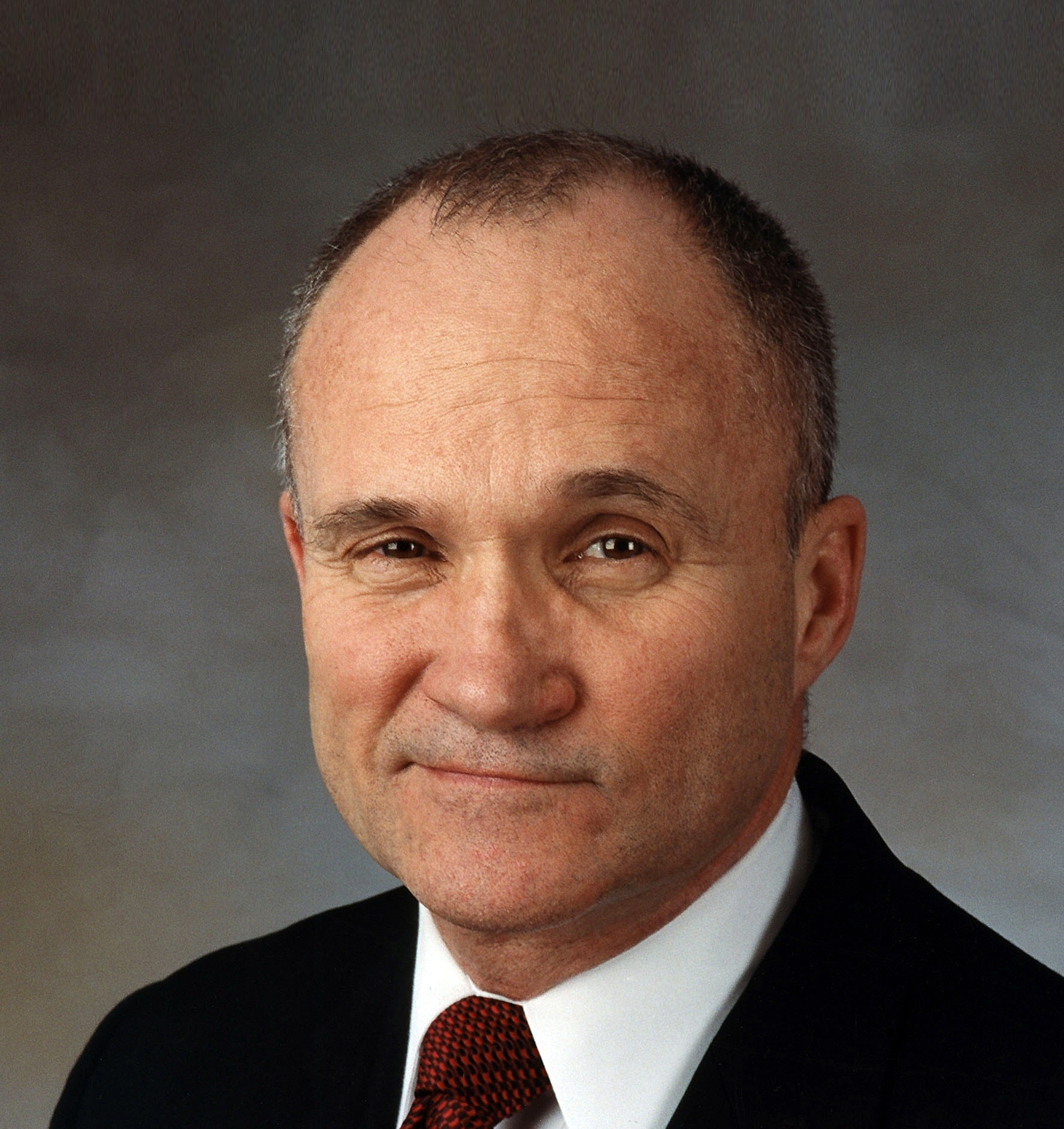
Recently, we had the opportunity to discuss cyber security with an expert, former New York City Police Commissioner Ray Kelly, who is president of Cushman & Wakefield’s Risk Management Services. Once the city’s longest-serving police commissioner, having served two terms under different mayors, David Dinkins and Michael Bloomberg, he now heads the first comprehensive risk management service of its kind in the real estate industry.
Mr. Kelly’s tenure as Police Commissioner included the follow-up to 9/11 and Hurricane Sandy. He has served as a consultant and commentator to ABC News on law enforcement issues, and he is currently writing a book about his decades of public service.
During his first term as NYC Police Commissioner (1992-1994), cyber security was “barely a blip on the radar screen,” according to Mr. Kelly. The NYPD had rudimentary computer systems and few investigators who were tech savvy. His second term as Commissioner (2002-2013) saw a sea change in the importance of cy- ber security. As the NYPD itself be- came more sophisticated in its use of technology, it became a bigger target for cyber-attacks. The department logged tens of thousands of intrusion attempts each day.
“We also needed to develop investigative expertise in order to respond to the escalating number and types of cyber-crimes,” said Mr. Kelly. Today, cyber-threats come from many directions: state actors, criminal groups, corporate espionage, terrorists and hacktivists. The risks for corpora- tions are enormous. A sophisticated cyber-attack can result in crippling financial losses, extensive legal liability and long-lasting reputational damage. For the real estate industry, the loss of confidential client data is probably the dominant cyber- risk. Other pro- fessional and financial services firms face similar risks. “Trust is a key element of our client relationships,” said Mr. Kelly. “If sensitive client data is compromised, that trust is also com- promised.”
Boards have come to realize the sig- nificance of these risks and of their potential liability if they fail to take prudent measures for data protection. One way for boards to mitigate their risk is to commission independent risk assessments by qualified outside experts.
Security breaches at corporations like Sony, JPMorgan Chase, Home Depot, and Target, sent shock waves through the American psyche. Mr. Kelly point- ed to lessons learned from these high profile breaches. “One key lesson is that cyber security is about more than the protection of your own network,” he said. Major vulnerabilities can ex- ist through the way networks connect with vendors and other third party providers. “A small plumbing company’s computer system may not seem like much of a target,” said Mr. Kelly, “but if it links to your system, its importance has increased exponentially.” The data security chain is only as strong as its weakest link.
And the perpetrators are everywhere.
“We see large numbers of attacks coming from China, Russia and Eastern Europe, Brazil, Nigeria and Vietnam,” said Mr. Kelly. In most cases, apprehending suspects in these countries is unrealistic. Robust defenses and a well-trained workforce present a better option. Social engineering remains a productive option for cyber criminals. When one of your employees clicks on a suspect attachment in a phishing campaign and malware is installed, your investment in network defenses has been undermined.
Staying ahead of security as real estate firms expand globally is an- other challenge, though Mr. Kelly doesn’t believe that cyber-risks will derail global expansion. “Certainly there are some countries that present challenging cyber-environments for business, but it would be a rare case where firms decide to take a pass on growth opportunities,” he said. The solution according to Mr. Kelly lies in conducting comprehensive risk assessments in advance of expansion and adopting reasonable mitigation measures that can pave the way to successful growth.
The risks of intellectual property theft can be reduced significantly by requiring a careful risk assessment of both physical security and informa- tion security. “Effective access control measures for office spaces need to be coupled with policies and procedures designed to make employees aware of their obligation to safeguard sensitive information,” Mr. Kelly said. “Matters of convenience (e.g. use of thumb drives and laptops with remote access) need to be weighed against their vulnerability to loss or theft. Terminated employees sometimes pose a threat to a firm’s intellectual property if they are able to download and export large amounts of data before their departure. Once risks are identified, prudent mitigation measures should be put in place.”
Going forward, improving security requires private companies to share intelligence, information on best practices and join together with government partners in various security initiatives.
That’s why, as Police Commissioner, Mr. Kelly established the Lower Manhattan Security Initiative. LMSI brings security personnel from Wall Street area firms together with NYPD counterterrorism officers in an area coordination center designed to share information and monitor conditions. Similarly, he began the NYPD Shield organization that brings private security leaders together with the NYPD in a detailed information and intelligence sharing forum. The Real Estate ISAC (Information Sharing and Analysis Center) is an excellent platform for disseminating important security information and often uses NYPD Shield as a source.
“CoreNet is an ideal forum for commercial real estate professionals to collaborate on security best practices. As the leading professional organization in the field, it has the credibility and reach to make a real difference in rais- ing the bar on security standards and practices,” Mr. Kelly said.
Commissioner Raymond W. Kelly is President of Risk Management Services at Cushman & Wakefield, where he focuses on helping clients identify potential vulnerabilities, as well as prepare for and manage risk across a number of critical areas. These include physical and cyber security intelligence, crisis management, due diligence/site selection, and emergency preparedness.
Tech Tips
By Sonya Verny, BDO, USA LLP and Carlie Hozza, Innovant, Newsletter Committee Members
Technology is a part of our everyday life. Whether we are sending an email, making a phone call or playing Candy Crush on the train, our technology is a constant presence in our day-to-day activities. By now you know that the Nigerian Prince emailing you is a scam, but did you know you can make your information vulnerable by responding to a text or returning a call? The following tips are for protecting your private information while using technology.
Device Safety
•
Always have password protection for your devices. Finger recognition is best, but PINs and swiped patterns are also options. Remember that it is possible to read PINs and swipes through phone smudges (grease patterns left by your fingers on the screen). Also, enable an automatic lock for when you haven’t used your device for a few minutes.
•
Understand your device’s privacy and security settings and which programs have access to your information. Data from the sites you visit, or even your location, can be included in the information you are allowing.
•
Not sure who sent you that text? Err on the side of caution and ignore it. Spam and phishing through text is becoming more prevalent.
•
Always keep your device software updated. System updates fix bugs and patch security gaps.
•
Only download apps from reputable developers and check the comment section for positive reviews. Malware can be installed through apps, but it is less likely when coming from well-known sources.
•
Back up your information frequently. Understand that backup systems, like iCloud, can do this automatically. However it also may back up information and images that you’d rather not.
Internet Safety
•
Turn off Wi-Fi and Bluetooth when not in use (bonus, it extends battery life).
•
Avoid submitting personal information over public Wi-Fi. Public Wi-Fi is not as secure, and people can capture your information.
•
Remember that an email can last forever. The Sony security breech not only com- promised employees’ identity, it also revealed offensive emails from executives. Think twice before sending emails that speak ill of others; it could come back to haunt you.
•
Sites with and https:// have increased security compared to http://
•
Beware of links and attachments. Do not open unless you know what they are, or were expecting specific information. Viruses spread by messaging the infected user’s contacts. Be cautious of short emails that include links or attachments. If someone hasn’t used your name and hasn’t signed it with their signature, the email might contain a virus.
•
Encrypt sensitive data. File encryption is easier now than ever, with free software available through Microsoft Windows and Apple Mac OSX.
Social Media Safety
•
Privacy and security set- tings exist for a reason. Learn about and use the pri- vacy and security settings on social networks. They help you control who sees what you post and manage your online experience in a posi- tive way.
•
Protect your reputation on social networks. What you post online stays online. Think twice before posting pictures you wouldn’t want your parents or future employers to see. Recent research found that 70% of job recruiters rejected candidates based on information they found online.
•Your online reputation can be a good thing: Research also found that recruiters respond to a strong, positive personal brand online. So show your smarts, thoughtfulness, and mas- tery of the environment.
•Keep personal info personal. Be cautious about the person- al information you provide on social networking sites. The more information you post, such as complete date of birth or address, the easier it may be for someone to steal your identi- ty, access your data, or commit other crimes such as stalking.
•
Know and manage your friends. Social networks can be used for a variety of purposes. Some of the fun is creating a large pool of friends from many aspects of your life. That doesn’t mean all friends are created equal. Use tools to man- age the information you share with friends in different groups or even have multiple online pages. If you’re trying to create
a public persona as a blogger or expert, create an open pro- file or a “fan” page that encourages broad participation and limits personal information. Use your personal profile to keep your real friends (the ones you know and trust) in touch with your daily life.
•
Be honest if you’re uncomfortable. If a friend posts some- thing about you that makes you uncomfortable or is inappro- priate, let them know. Likewise, stay open-minded if a friend approaches you because something you’ve posted makes him or her uncomfortable. People have different tolerances for how much the world knows about them. Respect those dif- ferences.
•
Know what action to take. If someone is harassing or threatening you, remove them from your friends list, block them, and report them to the site administrator.
Protect Yourself With These Tips:
•
Own your online pres- ence. When applicable, set the privacy and secu- rity settings on websites to your comfort level for information sharing. It’s ok to limit how you share information.
•
Make passwords long and strong. Combine capital and lowercase letters with num- bers and symbols to create a more secure password.
•
Unique account, unique password. Use separate passwords for every account helps to thwart cybercriminals.
•
Post only about others as you have them post about you.
Hacker Protection 101:
Interview with Adam Roth, VP of Technology at Virsig

|
by Alexandra Betesh, KBA Lease Services, Newsletter Committee
|
How safe are we from hackers? Will the next breach occur in our industry? What about our personal information, is it safe on the web? New cyber threats are constantly emerging as technology changes at an incredibly rapid pace. Can the experts protect us?
“Everyone has their own definition of cyber security” says Adam Roth, the VP of Technology at a New York City-based networked technology and systems integrator called Virsig. To Roth, it’s “securing the connections that lead to your virtual world.” Since he was a kid, Roth has been fascinated by security. He was glued to movies like War Games, in which a whiz kid hacks his way into the government computer systems and accidentally starts a war.” Now with over 30 years of experience, Roth is an expert in physical and cyber security. He holds licenses in armed and unarmed security, and has over 50 individual certifications.
But, the risks are compounding. Roth explains, “Over the past 15 years, more people have access to the internet than ever before. The pipes or bandwidths are larger, and it is easier to have anonymity as a hacker.” With the ubiquity of mobile devices, people make less
of an effort to secure their smart phones than they do their computers. Roth asks, “Do you lock your cell phone? A lot of people don’t.” A hacker can send you a malicious email containing a link that accesses your mobile device and exposes your personal information. Massive amounts of data can be stolen relatively easily. With a fake account and coffee-shop internet, a hacker becomes anonymous.
As a cyber-security expert, Roth categorizes both the major types of hacking and their underlying motiva- tions. Generally, hacking consists of breaking into servers or workstations, breaking through net- work devices (firewall switches and routers), or sending out malicious code. Some of this code, often known as ‘kiddie scripts’, can be purchased relatively easily on the black market. It leaves vulnerabilities open to exploitation and lets any regular person become a hacker. To combat the cyber criminals, it is important to try to understand how they think. Their motivations behind hacking can typically be categorized as:
White Hat Hacker
Someone who wants to show a big organization that they are not 100% safe. Usually a white hat hacker will directly communicate with an organization, and will, in some cases, be commissioned to identify the organization’s infrastructure weaknesses.
Grey Hat Hacker
Someone who wants to prove something. They often times can do damage to a network.
Black Hat Hacker
Someone who hacks with malevolent intent. These people can hold data for ransom, or they can be politically motivated. Governments employ this type of hacking as a part of warfare.
Can cyber-security firms adequately protect against these threats? Roth opines, “Cyber security companies have more limitations on them, as they have to act within the bounds of the laws. They have to be worried about the consequences on their actions.” Conversely, a lot of money has been spent by large organizations to hire some of the best hackers in the world and convert them into employees. These organizations use the knowledge of these hackers-for-hire to protect themselves. To Roth, cyber security includes both elements of physical security, which limits access to hardware (like modems or servers) that connects to your network, as well as online security, which prevents people from exploiting the internet.
As a first step, you should protect your basic data from being collected. A hacker must start with a piece of information about you or your organization. Hackers need a target system, a target IP, a person to exploit. “It is imperative that companies everywhere invest in educating their employees so that they know how to secure their data,” Roth says. For example, someone may call an administrative assistant, attempting to collect a name or email address. Although they may only give out their own email, a hacker, who can access the administrative assistant’s system, effectively gains access to the boss’s information as well. Companies should mandate that their administrative assistants collect the name and information of the caller. As a general rule, do not give out private information.
For hardware investments, companies should buy the right equipment for the right reasons. Roth warns, “You do not always need the most expensive and sophisticated system available. If you do not know how to secure a very sophisticated system, you will leave holes open and not even realize it.” For example, many people use a Universal Plug and Play (UPnP) router, without realizing that it actually puts your data on the internet, making your computer accessible and vulnerable. Research the right device. Spend your money wisely. Do not buy an incredibly powerful server when you do not need it.”
Firms should employ antivirus, anti-malware, and patch management on end-user devices. Many companies continue to use legacy software or hardware, and security patches are used to protect these relatively antiquated devices from new methods of sabotage. Roth advises, “As a best practice, when an operating system is retired, you should stop using it. If you have a lot of custom code written on these servers, then find the right security patches for your operating system. There are plenty of organizations that can tell you which patches are good and which are bad.” For example, if you have an older iPhone and you are being asked to upgrade the operating system on it, sometimes it may cause unanticipated problems. Sometimes, the new operating system may cause a quicker drain on your battery. This is an example of a poor patch management for a legacy device.
Finally, if something is not working properly, do not assume that it has been hacked. Disconnect the server and observe its behavior of- fline. Seek a professional to evaluate what happened. A hacker wants to get in, get your information, cover their tracks, and get out. If you think something was hacked, don’t get overwhelmed. Find the right people for the task.
Adam Roth has been working for Virsig since inception, only a few years ago. Virsig was started by 4 incredibly diverse and experienced individuals – one of whom is a former U.S. Navy SEAL. These individuals built an organization that is unique, leveraging their incredible backgrounds to consult for the government and Fortune 500 companies alike. They help Roththeir clients monitor and secure their network and teach best practices on how to keep their data secure. Virsig integrates both physical security and logical security where appropriate, keeping their clients’ data safe and secure so that they can have peace of mind.
Landmarked - Federal Reserve Bank of New York

|
by Thomas Reilly, Newsletter Committee
|
Located between the steel and glass skyscrapers of Manhattan’s financial district, the 22-story Federal Reserve Bank of New York (New York Fed) is distinctive for its palazzo design, reminiscent of the Italian Renaissance period. The building, completed in 1924, was designed to express strength, stability and security and to inspire confidence in the newly created Federal Reserve System. Ninety years later, the limestone and sandstone headquarters of the New York Fed remains an imposing and stunning architectural feat.
Design
The building was designed by York and Sawyer, which won a competition against six competing firms in 1921. Though architecturally out of sync with its time, Philip Sawyer’s design was commended for its simplicity, economy, and restraint. His design popularized an architectural style for banks that was repeated throughout the country.
Following the architectural competition, Samuel Yellin, an ambitious and talented metal worker, approached York and Sawyer with sketches of ornamental, but functional, ironwork to complement their conservative concept. The architects accepted the Polish-American artisan’s bid. Although Yellin was proficient in several styles, the designer employed an Italian technique consistent with the concept of the principal architect, Philip Sawyer. Many of Sawyer’s ideas were borrowed from Florentine palaces that had influenced him while studying in Italy. Specifically, the New York Fed’s monumental size suggests the Pitti Palazzo, while the structure’s façade molding recalls the Vecchio Palazzo, and the building’s stonework, arches and ironwork reflect the Strozzi Palazzo.
By mid-1923, the stone façade was in place. Though the period favored structures of uniform color, Sawyer elected to employ a multi-colored stone façade, which combined sections of Indiana limestone with those of Ohio sandstone. Sawyer’s reasoned that such a polychromatic facing would lend character to the building’s Renaissance style and break up the monotony of its walls, which are basically void of ornamentation. The decision was also economical as odd lots of unmatched stone were pur- chased for the job at a substantial discount. When completed in 1924, the New York Fed was the largest bank structure in the world, filling almost the entire block.
Landmark Status
The building was designated a New York City Landmark in 1965, and was listed on the State and National Registry of Historic Places in 1980. Its beautiful rusticated ashlar facade with alternating blocks of limestone and sandstone is unique in New York City, and its monumentality and solidity, combined with architectural detail, convey an air of permanence and strength. Besides making note of its impressive external architectural design and ornamental features, the commission drew attention to the grand entrance hall, vaulted ceilings, stone walls and ornamental ironwork in the public spaces of the Bank.
Restoration
Recently, the New York Fed undertook a multi-year effort to restore and modernize the building, the first major renovation since the 1930s. The restoration provided necessary up- grades to the building infrastructure, addressed safety concerns (including asbestos abatement, fire alarm and sprinkler enhancements and ventilation systems), and upgraded the building’s technology and electrical systems to ensure proper modern-day bank business and operational efficiency.
The floor-by-floor modernization process was aimed at making the building more functional, safe and flexible. The floors were reconfigured and upgraded to include new electrical, telecommunication, data, cable, fire alarm, sprinkler, elevator, air conditioning and ventilation systems, some of which were necessary improvements from the antiquated systems that dated from the 1930s. However, throughout the process, the project team attempted to retain as much of the original design as possible. Existing lighting fixtures and rare artwork, original to the building, were removed, refurbished, and reinstalled. Also, in an effort to balance historic preservation with modernized and environmentally-friendly facilities, the New York Fed restored existing wood doors, paneling, and trim work.
University & External Relations Committee Sends Students to CoreNet Global ERS

|
by Ashley Rigby, Education Specialist, Herman Miller, Inc.
|
As a millennial and young professional, I have had the opportunity to network with and learn from my peers, as well as with more seasoned professionals, since joining CoreNet Global nearly 8 years ago. In addition to the Young Leaders Community, the organization continues to seek out additional ways to raise awareness of the CRE industry and share how it’s positioned to support student and young professional members in a multitude of ways.
This past winter, a friend, business colleague and fellow CoreNet Global member mentioned that I should consider joining the newly-formed University & External Relations Committee. Immediately, I reached out to the committee chairperson and asked to get involved. CoreNet Global has made strengthening its relationships with academic institutions around the world a priority, and the University & External Relations Committee has been tasked with supporting that mission on a local level. Geographically, we are fortunate. New York City and the surrounding area is home to some of the most sought-after real estate programs both at the graduate and undergraduate level.
Over the past several months, the External & University Relations committee members have reached out to select local colleges and universities, raising awareness and sharing with them organizational benefits and programs available to young professionals interested in (or perhaps not even aware of) careers in corporate real estate. Benefits include reduced faculty and student membership rates, scholarships and sponsorships in addition exposure to potential mentors, employers and business partners. Oh, and of course, the endless opportunities for professional development are not to be overlooked.
The Academic Challenge was the first of our programs to support and promote. The Academic Challenge is a global competition created to attract students from all academic disciplines to tackle key challenges facing the corporate real estate profession, and those that are top of mind of CoreNet Global members. The competition closes at the end of July and it will be interesting to how students interpreted the complex challenge of improving a fictional corporate real estate portfolio and while positioning the organization for the greatest flexibility and success, all through the eyes of a CRE executive.
Most recently, we had the privilege of hosting a small group of students at CoreNet Global’s Eastern Regional Symposium in early June at Georgetown University in Washington, DC. We received over 30 applications from notable graduate-level programs, including those at New York University, Columbia University and Cornell University. The applicant pool was incredibly talented and which made whittling the list down to seven sponsored students challenging. Ultimately, the students awarded were selected because of their deep interest in corporate real estate, professionalism and academic achievements.
Over the course the two-day conference we had the opportunity to learn about the students, their professional interests and academic programs in a way that is not feasible simply by reviewing ones resume or reading a cover letter. It’s hard to believe, but they were more impressive in person than their applications conveyed.
The conference kicked-off with the Young Leaders Forum which took place over a beautifully-catered breakfast in the iconic Cosmos Club. Following that, they took advantage of a tour of the developing Capital Riverfront and the educational and inspirational sessions and speakers that followed. A highlight of the experience was an unplanned, but requested group dinner at Ray’s The Steaks, suggested by sponsored student, Chada Ngamwajasat. Over dinner the students shared personal and professional stories and chatted excitedly about opportunities to stay connected with CoreNet Global and one another as their careers unfold.
Following the event, Chada shared with me her thoughts on the Eastern Regional Symposium, her first CoreNet Global event, "I had the honor of being the only Sponsored Student representing NYU's Schack Institute of Real Estate at Corenet's Eastern Regional Symposium. While attending my first ERS, I had the benefit of interacting with real estate executives both in a formal and informal setting. Beyond the interactions that I had with leaders in the commercial real estate industry, I was also fortunate to connect with other Sponsored Students from Columbia University, Cornell, and Georgetown. I am so grateful to CoreNet and everyone that I met at the ERS for an amazing experience."
CoreNet Global and the New York City Chapter are smart to stay connected with the next generation corporate real estate executives. The student sponsors that were selected to attend the Eastern Regional Symposium clearly demonstrate that the future of this industry is incredibly bright.
Connected World: Tech Trends from 2015 Global Sourcing & Cloud Summit

|
by Jill Zunshine, Corporate Real Estate, Procurement, Supply Chain, and Operations Executive
|
I was delighted to attend the June 16-17 Global Sourcing & Cloud Summit presented by The World BPO/ITO Forum (www.worldbpoforum.com) at the New York Athletic Club in New York City.
Here is my takeaway on the Tech Trends discussed at the Summit. I call them “Connected World.” I grouped them into 6 Mega-Trends: Cloud, Big Data, Mobile, Disruptive Innovation, Growing Risk, and The New IT.
#1. CLOUD
“Total Cloud Market Cap up 7X since 2008, from $25 billion to $180 billion.”
– Chris Barbin, CEO & Co-Founder, Appirio
The market is concentrated, with the Top 10 Public Cloud Companies having 75% of the market cap. The Top 5 are Salesforce.com, LinkedIn, Workday, ServiceNow, and NetSuite. And, the Top 10 include 6 players who weren’t in the Top 10 in 2008: LinkedIn, Workday, ServiceNow, Veeva Systems, Medidata Solutions, and Proofpoint.
“Customization ≠ Cloud.”
– Charles Phillips, CEO, Infor
Cloud dislikes customization. It's much easier to move applications to the cloud when they aren't customized.
#2. BIG DATA
“IoT is here: 7.5 billion mobile connections, more than the number of people in the world.”
– Mark Weatherford, Principal, The Chertoff Group; First Deputy Under Secretary for Cybersecurity, U.S.
Department of Homeland Security
What is 7,527,562,797? It’s the number of mobile connections in the world at the beginning of this week, including Machine to Machine (M2M). Watch the number grow in real-time at GSMA Intelligence (gsmaintelligence.com). That’s more than the number of people in the world, now approaching 7.3 billion. To watch the world population grow in real-time, go to the U.S. Census Bureau (www.census.gov/popclock).
“Data is the new oil.”
– L.N. Balaji, President, ITC Infotech (USA) Inc.
Big Data is a precious resource. It fuels decision-making. And, it has an economic value.
#3. MOBILE
“Welcome to the era of the ‘ODD Millennials,’ On Demand Digital.”
– Chris Barbin, CEO & Co-Founder, Appirio
“Millennials love devices, e-commerce, online media, games, and wearables.” Verhage, Julie (2015, May 22). Bank of America: Here Are Eight Ways to Profit From Millennials. Bloomberg Business. Retrieved from www.bloomberg.com.
And, the ODD Millennials demand more and more minutes each day:
#4. DISRUPTIVE INNOVATION
“With the ‘Uber for talent,’ we’re harnessing the emerging global talent cloud.”
– Matt Swanson, Managing Partner, Silicon Valley Software Group
What will 2025 look like? A McKinsey Global Institute report examines “the current state of employment and the impact these digital platforms could have:”
Online talent platforms could add $2.7 trillion, or 2%, to global GDP by 2025, while increasing employment by 72 million full-time-equivalent positions.
Up to 540 million people could benefit from online talent platforms by 2025.
Adoption of these platforms could increase the output of companies by up to 9% and reduce the cost of recruiting talent and of human resources generally by as much as 7%.
James Manyika, Susan Lund, Kelsey Robinson, John Valentino, and Richard Dobbs (2015, June). A labor market that works: Connecting talent with opportunity in the digital age. McKinsey Global Institute. Retrieved from www.mckinsey.com.
“A photo of Tomorrow's call center, after robotic process automation.”
– Cliff Justice, Partner and U.S. Leader, Shared Services and Outsourcing Advisory, KPMG LLP
#5. GROWING RISK
“Risk = Threat x Vulnerability x Consequence.”
– Jim Noble, Summit Chairman; Former CIO of GM, AOL Time Warner, Merrill Lynch, BP, & Philip Morris
Risk can be thought of as an equation, where Risk is equal to the Threat, times your Vulnerability to the threat, times the Consequence if the threat became a reality. To reduce Risk, reduce all three variables in the risk equation.
“The average Fortune 500 Company has 700 cloud applications, and IT is aware of 100.”
– Alan Guibord, Co-Founder & President, Cyber Security Integrators, LLC
#6. THE NEW IT
“CIO: Chief Executive, Salesperson, Diplomat, Venture Capitalist, Product Manager, & Recruiter.”
– Jim Noble, Summit Chairman; Former CIO of GM, AOL Time Warner, Merrill Lynch, BP, & Philip Morris
A Chief Executive of your technology business supporting the demands of speed and agility.
A Salesperson engaging internal customers on their biggest challenges while attracting the best talent and suppliers.
A Diplomat interacting with Board Members as a trusted advisor to solicit their concerns and share your results.
A Venture Capitalist showcasing the “art of the possible” to internal customers with promising ideas.
A Product Manager assembling products through experimentation with customers and partners.
A Recruiter motivating and retaining the best talent.
* * *
It was fun, any way you look at it. I wanted to attend last year, but I couldn’t. I’m glad I didn’t miss it this year.
CoreNet Global New York City Chapter Hosted Sold-Out Workshop: Perspective on Manhattan West
NEW YORK, NY—May 22, 2015—The New York City Chapter of CoreNet Global (CoreNet NYC) is pleased to announce that it hosted its sold-out Workshop: Perspective on Manhattan West at Brookfield Place.
Future Landlords and Tenants Gather at Sold-Out Workshop for Details on New Development
CoreNet NYC hosted its sold-out workshop entitled “Perspective on Manhattan West” that gave both prospective landlords and tenants an in-depth look into Brookfield’s Manhattan West development. Brookfield Property Partner presented details on the pending development and future plans for Manhattan West. Tenants who have committed to the project including R/GA and Skadden, Arps, Slate and Meagher & Flom LLP, also provided commentary on their hopes for the development and its future.
Manhattan West will be a 5,400,000 SF multi-use development by Brookfield Properties. The project will consist of two large office towers and two smaller residential towers with 1.5 acres of public park. The project is estimated to be completed in 2020.
Generations in the Balance
Baby Boomers…Generation X…Millennials. This unlikely trio of ages and values is competing and collaborating in today’s workplace. With divergent backgrounds and experiences, they meet daily in work spaces that are inherently comfortable for some and inherently awkward for others, but all must adapt. Baby boomers, some still employed long past the traditional age of retirement, feel exposed with the loss of their private offices and cubicles. Generation Xers embrace flex time and long for employment that supports their team spirit. Millennials, raised on technology, thrive in collaborative work spaces but grouse about having to pay their dues to move up the corporate ladder.
Millennial speak: “Those baby boomers can’t keep up with technology.”
Generation X speak: “We’re highly educated, and we have a new paradigm. It’s not about the goal. It’s about the team.”
Baby Boomer speak: “While younger workers bail, we understand economic cycles and have the wisdom to weather any storm.”
With these diverse mindsets, can consensus be reached?
We recently spoke with Suzanne Heidelberger, who is Senior Vice President of Global Real Estate and Workplace Enablement at American Express, about the role real estate plays in helping the generations coexist and thrive. Heidelberger considers herself “a Generation X with a Baby Boomer soul.” She said, “All three generations need to have a voice and contribute equally.” When that happens, “solutions are robust, logical, and ultimately deliverable.”
The biggest difference in the three generational groups is technology. “Baby boomers want to keep up with the Millennials,” Heidelberger said. In terms of real estate challenges with burgeoning technology, she said, “It’s about managing expectations for technology and keeping up with the rate of change. The organizations that are able to make the necessary investments in new technology have a competitive advantage.”
Statistics continue to support Baby Boomers’ predominance in the workforce, but while they’re working longer, they’re also reinventing themselves. Boomers are acquiring new skills, and once they retire, seeking part-time employment. It’s an interesting juxtaposition that as Baby Boomers approach retirement, “they start acting more like Millennials,” according to Heidelberger.
But let’s not skip over the Gen Xers. While not nearly as large a demographic as Baby Boomers, they are older, more experienced, and, based on where they are in their careers, more likely than Millennials to be transitioning into leadership positions in corporate America.
Gen Xers’ adherence to a team approach supports productivity according to Heidelberger because “people are allowed to work in ways and in spaces that make the most sense to them.” Translating that need to real estate, “We look at providing spaces where people can be the most productive, which leads to more engaged employees and a better return on property investment.”
A recent survey of 4,100 business executives in medium-to-large corporations by Accenture, a management consulting firm, revealed that for more than half of men and women, work-life balance — ahead of money, recognition, and autonomy — is the essential characteristic of a successful career. The majority of employees surveyed believe they can have both a successful career and a full life outside work. Work-life balance is so important that more than half of those surveyed turned down a job offer because of the potential impact on their lives outside of work.
The work-life balance has a profound effect on both commercial and residential real estate. With more employees taking advantage of flex time and working remotely, “you can put more people into less bricks-and-mortar real estate,” said Heidelberger. “It’s a mindset shift from simply being present to being focused on results.” Enabling employees to balance work with lifestyle and exercise provides organizations with a magnet for attracting the best and brightest talent. The current trend to urban living certainly supports what workers expect in terms of flexibility and balance. Today’s cities provide most services and amenities, including culture, education, housing, and healthcare, within the urban core. Lower commute times further encourage living and working in the city. Heidelberger sees this trend continuing for all three generational groups.
The demand for urban space has caused many to adapt. For example, while fringe areas have always attracted creative types and the younger generation, many previous fringe areas are now in vogue and have increased significantly in price. Heidelberger cited a warehouse area in Tribeca that was known for years as an artists’ colony. “With the rising cost of real estate, those artists have become developers,” she said.
As generations transition, so has the conception of the American Dream, from owning a little house with a white picket fence to a McMansion, and now to a city loft. But, whatever the dream, “we’re all trying to do the best we can,” said Heidelberger, “using our brains for good and developing tools that help us along the way.”
Suzanne Heidelberger is a past chair of CoreNet NYC and is Senior Vice President of Global Real Estate and Workplace Enablement at American Express.
Ask the Millennials: Corporate Leader Interview
By Alexandra Betesh – KBA Lease Services and Thomas P. Reilly – Federal Reserve Bank of New York, Newsletter Committee Members
Baby Boomers, Gen X-ers and Millenials all have extremely distinct identities, reflecting their respective experiences in business and the world around them. Tom Vecchione from Gensler and Jake Merriman from Gen Y Catalyst share their experiences and opinions on how these generations are impacting our cities.
The contrast amongst Baby Boomers, Gen X-ers and Millennials in the workplace is striking. Boomers, born between 1946 and 1964, are currently focused on their legacy. They are enjoying the last part of their life cycle in business, and are often perceived as extremely confident. X-ers, born between 1965 and 1979, present themselves as fiercely self-sufficient. They do whatever it takes to prevail, and are willing to pay their dues. In contrast, Merriman explains that Millennials, born between 1980 and 2000, think that they can “be and do whatever they want.” They have their fingers on the pulse of business and believe they can generate value.
These differences create a challenge when the generations work together. Boomers and Xers need to learn how to stay current, collaborate, and be more nimble. Millennials need to learn how to thicken their skin to the harsh realities around them, to hustle, and show up when they are supposed to. Despite their youth, Millennials are starting to assert themselves, demanding hyper-connectivity, upward mobility, and a fair work-life balance. They seek mentorship and easy access to knowledge from their employers. Merriman explains, “Millennials have been raised and reared to have a tribal mentality. They want to be around other people that think like them, act like them, and have aspirations like them.”
Vecchione believes that urban living attracts Millennials because the inherent density, co-location, and adjacency nurture them. “Many attributes about how Millennials see life, career paths, cultural goals and hyper-connectivity are representative attributes of cities themselves.” Merriman further explains, “They want to be around the action, and that action is in the cities.” Both Vecchione and Merriman expect that cities, and especially New York, are going to become bigger and denser, with rampant innovation as different businesses intersect. For example, in New York, the tech sector is embedding itself within fashion, media, healthcare and finance industries.
While these cultural changes and developments are occurring, there will be a shift in New York’s real estate landscape. On the residential side, the strong culture of connectivity and collaboration is bringing about rapid gentrification. Vecchione explains that, “In the 70s and 80s it took areas in New York nearly 20 years to reinvent itself in contrast to Brooklyn and Queens, which have only taken 10 years.” He sees “a very bright, dense, vibrant, and exciting city ahead of us – probably the number one city in the world.” Vecchione adds, “We are neck-in-neck with London economically, but I think the global wealth markets will shift us and we will be in an unparalleled place like we haven’t been before.” Merriman believes “The collaboration exhibited in Millennial culture will transform New York from a place where ‘I am great,’ to ‘we are great’ and ultimately to a place where life is great.”
On the commercial side, employees’ needs are becoming more intertwined with real estate. Real estate can play a large role in shaping their identity as an employee, and will become increasingly integral to employee productivity and retention. Vecchione thinks that this is a “wildly creative time” in the world of corporate real estate because, “if you can have something to do with how the population is shifting and who sits next to each other, you have an incredible amount of power.” Merriman agrees, “The workplace must be congruent with how they see themselves as a professional now and what they aspire to be. If corporate real estate can align with that, they are going to win.”
“In order to move forward, corporate real estate will need to collaborate with the business leadership and research the metrics behind performance,” says Vecchione. Furthermore, although some ventures will fail, Vecchione states, “We cannot be afraid to test the waters in sales or structurally shift certain things. Corporate real estate groups need to understand people and what they all do. They need to know what happens if all the rules are broken and we need to start with a completely different set of guidelines. Once they are less dependent on that structure, they will truly be able to add value. Just ask the Millennials.”
Tom Vecchione “loves to build things.” Vecchione joined Gensler, the global design firm, 25-years ago after studying urban planning at Cornell, and is currently a design director and principal focused on workplace strategy and master-planning. He helps businesses and cities, “take their portfolio and environment, and align it with what is transforming in their business and culture.” Tom has developed an international portfolio of workplaces and corporate campuses for top performing companies working on projects in NYC, Boston, Tokyo, Dubai, Cairo and Zurich.
Jake Merriman is the founder and CEO of Gen Y Catalyst, a Millennial Entrepreneurial Think Tank. His primary focus is to help Millennials become high impact leaders. He has helped hundreds of Millennials leverage their value in the marketplace. He believes that the biggest challenge today is help them “work together to impact the marketplace effectively and continue the growth of the economy.”
ArtSpace: From Artist Advocate to Real Estate Developer & Owner
Artspace started thirty years ago with a single person advocating for affordable housing in a warehouse district in MN. This initial effort served as a catalyst for innovative P3 (public private partnership) collaboration and financing across the country, resulting in $582 million and 3,440,962 square feet in total development. Working with community leaders, Artspace has creatively developed sustainable communities and preserved some of our nation’s historical and cultural heritage through adaptive reuse and ground up development. Harlem’s El Barrio’s Artspace PS109 demonstrates how Artspace, the nation’s leading developer for artist live/work space, pioneered and now masters “Forever Affordable”.
Affordable housing in New York City has always been a challenge, but of late it has become almost intractable. This situation is fueled by a multi-generational swell in the city where older NYC residents are aging-in-place. Baby-boomer empty nesters are remaining in the city after their children leave. Young Gen X families are opting out of transitioning to the suburbs and staying in the city to raise their children.These trends,compounded with the millennium generation continuing to be drawn to New York City, are increasing demand for housing that is easily outpacing supply. In addition, the gap between wages and rent has widened. Over the past 20 years, wages have increased less than 15% while the average monthly rent in NYC has increased 40%, making it more and more difficult to find affordable housing. To address this crisis, Mayor DeBlasio launched Housing New York A Five-Borough Ten-Year Plan.
While the affordable housing challenge is daunting and complex, Artspace (who was cited in DiBlasio’s plan) holistically integrates affordable housing into historic and cultural preservation and community revitalization.
They are the nation’s leader for artist-led community transformations. Artspace’s latest project, done in partnership with the City of New York and El Barrio's Operation Fight Back (an East Harlem community development organization) is a historic and cultural preservation of Public School 109 (PS109). Originally built in 1898 in the Gothic Style by Charles B.J. Snyder, the property has been redeveloped through adaptive reuse to create an artistic community with 89 affordable live/work units, 10,000 square feet of commercial space and 3,000 square feet of common community art space. To preserve their cultural heritage, 50% of the units associated with this $52 million project are dedicated to those already living in the El Barrio neighborhood. Some of the goals for the project include:
• Anchoring and further catalyzing El Barrio’s dynamic cultural mix and helping a changing community retain its identity
• Facilitating economic growth during construction and operation
• Engaging 1,000+ residents
• Bringing an important historic building back to life
El Barrio, which is scheduled to be occupied in 2015, is the third project that Artspace has completed in New York; the first was the 60 unit $17.6 million Artspace Buffalo Lofts, followed by the 45 unit $18 million Patchogue Loft complex in Long Island.
While their methods and results are unique and often considered magical, the beginning of the Artspace story is a familiar one. After witnessing artists being financially squeezed out of neighborhoods they created, Artspace founder Kelley Lindquist began advocating for affordable space for artists and arts organizations. He became painfully aware of artists’ transient cycle of moving, settling into a raw venue, developing an infrastructure and a community, and then having to start all over again in a lower rent district. This cycle of constantly moving highlighted the fact that the problem was not just finding artists affordable live and work space – the problem was finding space artists could stay in year-over-year.
To break this cycle, Artspace realized that they needed to own and manage the space for artists. With no experience in real estate development, ownership, or management, but lots of passion and commitment from a core team, Artspace sought funding and started building relationships. In addition to funds specifically targeted for the arts, Artspace researched the newly introduced LIHTC (low income housing tax credits) and determined that this financial instrument could be applied to housing purposely built or restored for artist’s live-work space. Since many of their future projects would likely involve renovation of historic properties, they also sought historical preservation funds. Many private and public foundations and funds currently contribute to Artspace project funding.
After initial success in Minneapolis, Artspace’s reputation grew. New projects are generally initiated by a community – not by Artspace. To create “forever affordable” and sustainable properties, Artspace understands that planning and due diligence are critical and relationships are paramount. Projects range in size from 10 to 100 units,but despite the size of the project, all use a multi-year, multi-functional approach in which local artists, community leaders and town officials are active members of the planning and implementation team.
Artspace's mission is to create, foster, and preserve affordable space for artists and arts organizations.
Artists who live and work in an Artspace development are part of a “sharing economy.” Gallery space as well as tools, supplies, and equipment are often shared, and common areas such as hallways, double as collaboration and exhibit space. Melodie Bahan, Artspace’s Vice President of Communications, suggests that these inspired environments create a platform where diversity is embraced and cross-genre and cross-generational collaboration is fostered. A sense of community is created where artists share in the overall leadership of the community and the management of the property. In general, each Artspace community has artist committees to manage exhibits and events to support “livability” and to select potential tenants. Few will argue the intrinsic value of “Creative Placemaking”, in which cultural assets are leveraged to strengthen the social fabric of communities, but Artspace has actually measured it. In a recent Artspace study entitled “Taking a Measure of Creative Placemaking”, 75% of tenants were surveyed across five projects. The responses indicate that living in an art space increased their productivity and income by approximately 30%.
Artspace designs their projects to suit the unique needs of artists. They often include features that may be more costly, such as wider doorways and higher ceilings. To keep artists continuously in-residence at their properties, Artspace does not “flip” their properties; instead they aggressively refinance and tightly manage their properties to make them “forever affordable”. The American dream of home ownership is not dead according to Bahan, but rather it is being redefined, personalized and customized for artists and others.
Originally started to focus on the needs of the under-served artist market, Artspace has demonstrated that artists are an under-leveraged community resource. When asked what New York real estate professionals can learn from Artspace Projects LLC, Bahan highlights how much Artspace learned from their New York partners. She stated that the keys to their success were listening and agility. They have a proven tool-kit and they remain committed to understanding and satisfying the unique needs of specific communities and preserving the cultural integrity of the neighborhoods they serve. Artspace projects generally take longer to plan, but through the power of multi-functional teams and collaboration, they achieve financial, social, and environmental sustainability.
CoreNet NYC Hosts Women's Community Event - "Embracing Change: Communication Strategies in Turbulent Times"
NEW YORK – March 24, 2015 – CoreNet Global New York City Chapter (CoreNet NYC) is pleased to announce that it hosted a program entitled “Embracing Change: Communication Strategies in Turbulent Times” on Thursday, February 26, 2015 at Skadden, Arps, Slate, Meagher & Flom LLP in New York City.
Motivation Through Storytelling
Over 100 CoreNet NYC members and guests attended the presentation by Dr. Robert J. Bies, Professor of Management at Georgetown University, to learn effective leadership skills. In the first section of his presentation, Dr. Bies offered sound advice and personal anecdotes on how to use “storytelling” as a key communication tool to motivate people. Dr. Bies’ advice included some verbal do’s and don’ts: “Don’t say if, say when…Don’t say but, say imagine.” He also suggested changing up the pattern of speech to make a greater impact, “speed up, slow down, raise your voice,” and he reminded people of “the power of pause, of silence.”
Learning by Doing
In the second half of the program, Dr. Bies guided guests through a group exercise to help them practice motivating an audience by finding a focus in their communication. He asked them to “let the key phrase of what you want people to remember be the driving principle.” After the exercise, guests enjoyed a light reception and the opportunity to network and practice what they learned.
CoreNet NYC Discusses Preparation for Future Superstorms in the Wake of Sandy at Mohawk Showroom
NEW YORK – March 10, 2015 – The New York City Chapter of CoreNet Global is pleased to announce that it hosted a program entitled “Resiliency: Are you Ready for the Next Superstorm?” which was held on Wednesday, February 4, 2015 at the Mohawk Showroom at 71 West 23rd Street in New York City.
Hussain Ali-Kahn, Director of Strategy at CBRE, moderated a distinguished panel of speakers from highly respected companies:
-
Vincent Warner, Managing Principal of WB Engineers
-
Michael Sciara, Principal and Vice President of John W. Baumgarten Architect
-
Chip Logan, Director of Global Real Estate at BNY Mellon
The Devastation of Sandy
The panel discussed the threat posed by Superstorms in the aftermath of Hurricane Sandy, and how CRE professionals can best help prepare their companies and their communities for potential future disasters. Panelists recounted severe damages incurred by Superstorm Sandy, including loss of power to buildings such as hospitals and flooded basements. Said Mr. Logan, “No one thought a storm like Sandy would hit this City. No one was ready, and preparation was insufficient. I remember downtown Manhattan looking like a third world country.”
Next Time, We’ll Be Ready
Panelists lauded the resiliency of New Yorkers in weathering the storm. They offered several recommendations in preparation for potential future storms including the addition of submersible generators to critical facilities, greater quantities of materials to redirect water such as sandbags, and more sophisticated pumping systems.
CoreNet NYC Hosts Sold-Out New Year's Celebration at Newly Reopened Rainbow Room
NEW YORK – January 16, 2014 – CoreNet Global New York City Chapter (CoreNet NYC) is pleased to announce it hosted its Annual New Year’s Party on Thursday, January 9, 2014. This year’s event was held at the Mandarin Oriental in New York City, a larger venue that could accommodate record attendance for the association’s annual New Year’s event.
Over 350 CoreNet NYC members and guests from the corporate real estate industry gathered to celebrate the start of the New Year. While looking to the year ahead, the organization hopes to continue its momentum in 2014 after being recognized as the 2013 CoreNet Global Chapter of the Year.
CoreNet NYC Hosts Discussion with Arianna Huffington to Redefine Success
NEW YORK – November 26, 2014 – The New York City Chapter of CoreNet Global (CoreNet NYC) is pleased to announce that it hosted a special program featuring Arianna Huffington entitled, “Redefining Success: The Third Metric That Can Benefit Your Bottom Line” on Wednesday, November 12, 2014 at the W Union Square in New York City.
Arianna Huffington, the chair, president and editor-in-chief of the Huffington Post Media Group and one of the most influential women in the world engaged with CoreNet members and commercial real estate professionals in a discussion focused on health and wellness in a work climate where people are continually putting themselves at risk of over-working. Huffington demonstrated how the workplace can have a significant influence on employee productivity and success. Using her own offices as an example, Huffington added that many professionals may still be hesitant of accepting innovative ideas: "Nap rooms in the city that never sleeps? In the middle of a news room? There was a lot of skepticism."
Adding Happiness as a Third Metric To Define Success
Huffington cited her own collapse in 2007 as her wakeup call that led her to reflect on the true meaning of “success” and a “good life.” She began to question conventional wisdom: “We’ve been defining success by two metrics: money and power. But that’s like trying to sit on a two-legged stool. We need that third leg.” Huffington explained that the “third leg” is creating a sustainable and happy life and it begins with keeping stress under control: “75% of all healthcare costs and problems are attributed to stress in some direct fashion, while only 25% are beyond our control.”
Embracing Health and Wellness to Increase Success
She attributes a reliance on technology and unhealthy work habits as major contributors of stress: “We are actually taking better care of our smartphones than we are of ourselves…technology promotes burnout…and multitasking makes us less effective.” The solution, Huffington suggests, is meditation: “Very effective people meditate 2 times a day for 20 minutes – if this is a challenge, start small with 5 minutes and see the impact to your well-being.”
Huffington advocated for being aware of one’s health so as to avoid exhaustion and impairing judgment. She recounted: “Every hiring mistake I made was when I was tired,” adding “leadership is noticing the icebergs before they hit the Titanic, and it is harder to do in a tired state.” Huffington warned against using “busy as a badge of honor,” reminding the audience that it is O.K. to say “no” to work that you cannot do, stating “Learn to be ok with silence. No is a full sentence. Go be quiet.” Instead, she suggested using the time to build connections with other people such as co-workers, family, friends and acquaintances, who may otherwise be taken for granted.
Capital Liquity Sustains Recovery
It’s 2014 and the real estate recovery continues to gain momentum, but according to David Eyzenberg, Principal, Investment Banking (Real Estate Debt, Equity & Structured Capital) at Avison Young, a confluence of recovering market fundamentals and sustainable capital flows will be required to keep it going.
Before the financial crisis (pre-2008), businesses boomed and people were flipping properties faster than pancakes at IHOP. But after the fall of Lehman Brothers and the bank bailouts, the door to credit slammed shut. Now that recovery is underway, has credit eased?
“It’s partially true that access to financing has gotten easier, but the debt markets have also gotten better at funneling credit to where it needs to go on a risk-adjusted basis,” said Eyzenberg. “There’s tremendous li¬quidity for transactions involving core assets, at spreads on par or better than pre-2008. However, credit for deals with value added components in secondary markets continues to be disciplined.”
Eyzenberg expects an increase in the availability of real estate credit from the five primary sources: commercial banks, insurance companies, commercial mortgage backed securities (CMBS), finance companies (including mortgage REITS), and fund managers.
Part of what David Eyzenberg does at Avison Young is to arrange debt for real estate transactions. “We have seen a sizable shift in our business from existing asset financing to de¬velopment transactions. Though we continue to work on acquisition and refinance transaction, we are finding it more advantageous to focus on sol¬id development transactions, where some form of structure is required.”
Banks will continue to compete on price to put attractive paper on their recovering balance sheets. Addition¬ally, they have become more open to doing construction loans, though no¬where near pre-2008 levels. “A recov¬ering economy will help rationalize going out a bit on the risk spectrum, maybe not on a leverage standpoint but to weaker capitalized borrow¬ers and B quality assets in search of yield,” Eyzenberg predicts.
Insurance companies will continue to grow their books by focusing on high-quality, fixed-rate loans. It’s possible that a widening spread between corporate bonds and commercial loans may make lending less attractive but, with an expected increase in interest rates, that is not likely to occur.
CMBS markets are not likely to return to their pre-crisis peak but are still expected to stabilize at healthy, sustainable levels. In short, private lending markets do not have enough capacity to handle the coming debt maturities, and a vibrant CMBS is of paramount importance to sustain the current recovery.
The shadow banking market, composed of non-regu¬lated debt providers, will continue to make risky loans and will fill the gap created by any pull back from traditional entities (potentially because of over regulation). Mortgage REITS, finance companies and credit private-equity funds will continue to increase their stakes, as a recovering market is more forgiving to aggressive lending.
Whether private equity or hedge, fund managers will con¬tinue to chase yield by providing gap capital. “Mezzanine financing, a loan where the collateral is the partnership in¬terest of the borrowing entity, will continue to be attractive on a risk-adjusted basis for longer term credit providers at reasonable leverage. However, those seeking to leverage con¬struction loans will find gap capital in shorter supply and more expensive when available.”
Eyzenberg‘s practice also spans structuring joint ventures between private owner/operators and institutional equity providers. Right now, foreign investors “are bringing money in at breakneck speed.”
He cited China and Canada as just two of the robust economies investing in the U.S. “It’s created liquidity for the markets.” Is it challenging for foreign investors to finance projects? “It depends. Many foreign investors simply acquire assets, all cash, thereby circumventing the financing process. When that is not possible they either turn to the local office of a do¬mestically domiciled lending institution or get financed via the local JV partner’s relationships.”
Eyzenberg sees more competition from foreign owned firms to acquire properties. “Foreign capital is perceived as lower cost of capital, so they’re aggressive, and consequently, com¬petitive.”
Does he worry that the investment climate will spur over¬building?
“It’s hard to overbuild due to the availability of information regarding new developments. The lending industry has become very efficient with self-policing. I don’t worry about supply. I worry about demand fluctuations due to unpredictable ex¬ogenous factors.”
How has the Fed’s quantitative easing and zero interest rate policy affected the availability of credit?
“When interest rates go up, I don’t see how much tighter risk premiums can rise,” said Eyzenberg. “If you look at the buyer who needs leverage, he gets hurt. Well capitalized in¬stitutions aren’t effected by interest rates like entrepreneurs. On the institutional level, there’s so much demand to deploy capital that small fluctuations won’t mean that much. They would have to go way up to make any difference in invest¬ment behavior patterns.”
Bottom line?
“I worry about any loosening of discipline,” said Eyzenberg.
“Things are great until they’re not.”
David Eyzenberg is a Principal in the New York office of Avison Young, where he focuses on capital raising/
structuring for Avison Young’s CRE clients. Mr. Eyzenberg’s practice spans entity and asset recapitalizations, financing debt and property acquisitions/developments, as well as advising Canadian and domestic institutions on deploying capital into appropriate opportunities. Complementing his professional endeavors, Mr. Eyzenberg teaches graduate real estate finance studies in New York University’s Masters of Science in Real Estate program.
Mr. Eyzenberg previously served as Managing Director and head of commercial real estate for NewOak Capital, a New York-based financial advisory firm. There, Mr. Eyzenberg completed multiple property financing and CMBS/CRE CDO valuation assignments. His tenure at NewOak began in 2011 after its acquisition of the investment banking practice of Eyzenberg’s Prodigious Capital Group, where Mr. Eyzenberg served as President since 2005. There he led the firm in consummating over $350M in financing and advisory assignment. Prior to running Prodigious Capital Group, Mr. Eyzenberg was associated with several boutique real estate investment banks where he participated in over $650M of financing transactions. Mr. Eyzenberg began his real estate career on the buy side working for Merrill Lynch, Greenstreet Partners and Ramius Capital Group.
Mr. Eyzenberg is a graduate of New York University, where he received a Bachelor’s Degree and a Master’s Degree in real estate finance and investment. He serves as President of the NYU Schack Real Estate Institute Alumni Board and also sits on the Advisory Committee of the NYU Schack Real Estate Institute. Mr. Eyzenberg is an active member of ULI, ICSC, RELA, YMBA, Corenet, MBA, and is a frequent speaker at industry events.
CoreNet NYC and Joe Azelby of JP Morgan Present Tips for Success
NEW YORK – November 7, 2014 – The New York City Chapter of CoreNet Global is pleased to announce that it hosted a presentation entitled “Kiss Your ‘BUT’ Good-Bye,” which was held on Wednesday, October 21, 2014 at the Hippodrome at 1120 Avenue of the Americas.
The CoreNet Women’s Special Interest Group (CoreNet SIG) invited members and guests for a special presentation with Joe Azelby, Managing Director and CEO of JP Morgan Asset Managements’ Global Real Asset Group and co-author of “Kiss Your But Good-Bye: How To Get Beyond The One Word That Stands Between You and Success.”
The presentation highlighted some simple and practical ways to overcome individual weakness
to achieve desired career and personal relationships. “B-U-T is a very powerful word. It nullifies every word that comes before it and magnifies every word that comes after it,” stated Mr. Azelby as he urged the audience to find their individual “buts”—whether it’s a lack of skills, a distracting behavior or a personality quirk that interferes with achieving success.
The presentation took place at the newly redesigned and updated Hippodrome, boasting a new and expansive two-story lobby, operating the smartest building systems available and finished in classic Italian marble, limestone and silver leaf.
CoreNet NYC Presented Innovation Workshop featuring Big Data, Energy Efficiency and Sustainability
NEW YORK – November 7, 2014 – The New York City Chapter of CoreNet Global is pleased to announce that it hosted a workshop entitled “Innovation Forum,” which was held on Wednesday, October 22, 2014 at the Haworth Showroom.
A distinguished panel of industry representatives from big data, energy efficiency, sustainability, and the NYC New Local Legislation shared their ideas and products for corporate real estate and workplace management:
• Andre Tuluca, RA, Vidaris Inc.
• Brian Lehon, Haworth
• Nadine Cino, Tyga-Box
• Nora Fay, Lucifer Lighting
• Jenna Tatum, Mayor’s Office of Long-Term Planning and Sustainability
• Jeffrey Lipitz, 3M Architectural Markets
Innovations in Commercial Real Estate:
In presenting their latest products, the speakers discussed ways to improve idea generation and
workflow:
• Brian Lehon, Haworth – “Bluescape allows you to show progression of how things are
getting done. A living document that an unlimited number of folks can log into and
designed for today’s mobile worker. Facilitates fluid ideation and rapid interaction with
uninterrupted idea flow.”
• Nadine Cino, Tyga-Box “An idea hiding in plain sight.”
• Jeffrey Lipitz, 3M “reuse, repurpose with limited downtime.”
The News Funnel Q&A: Michael Davidson, Head of Real Estate - Americas East & New York Headquarters, JPMorgan Chase
As usual, New York City is currently at the forefront of discussions among real estate professionals from around the country, especially as it begins to generate additional momentum as a burgeoning hub for technology startups. In light of this, we spoke with Michael Davidson, the head of real estate – Americas East and New York Headquarters at JPMorgan Chase, about the convergence of technology and real estate, as well as the future outlook for the city’s real estate market moving forward, for this FunnelCast Q&A.
FunnelCast: What is your background and how did you enter the real estate industry?
Michael: I went to Fordham University and graduated in 1994. I ultimately ended up in real estate through an introduction made by the dean of students at the time (now president of the university) Joseph McShane, who introduced me to David Arena when he was at Morgan Stanley. Oddly enough, I’m still working with him to this day at JP Morgan.
FunnelCast: What is your view on the future outlook for the New York City real estate market, especially Brooklyn, giving all of the attention it’s been receiving recently?
Michael: I don’t want to speak on behalf of JPMorgan Chase, I’ll just give you my view as a real estate professional. New York is the financial capital of the world. It’s a hub for business. It’s a hub for culture. New York has continuously evolved over the years as a melting pot, a home for all sorts of people. Bringing it back to real estate … all of that makes it a place where people want to live and work. I think the future prospects for New York, based off of all of this, is fantastic. To answer the second part of the question, I’ve heard the words “tech hub” and “tech triangle” assigned to Brooklyn and I think there’s a validity to that, because you can get more space for your money compared to locations like Midtown. The construction of buildings in Brooklyn also lends itself to the types of very open and collaborative work environments that young people are seeking. In the end, real estate always follows a trend in the ways people are living and working.
FunnelCast: How are technology and the real estate industry comingling right now?
Michael: Even with the advent of so much technology that is making us more efficient, faster and better, no one should forget that the actual location and work environment companies are placing people in are still just as important as the technological advantages they are equipping them with. There are three elements at play here: technology, people and real estate. Efficiency, and ultimately success, is determined by how each individual company manages these three elements.
FunnelCast: What role do you see technology playing in the commercial real estate industry in the future?
Michael: In terms of the use of personal technology, many companies are trying to spearhead the latest initiatives when it comes to clients. Part of the potential problem, though, is that there are so many different platforms, and I think we as an industry need to decide what technologies work best and what makes the most sense. Technology forces businesses and people to think more than ever about what it is and what they truly need. If a person or a company is rushing out every time they see something new, that’s a dangerous process to get into.
FunnelCast: Congratulations on being named Corporate Real Estate Executive of the Year by the New York City chapter of CoreNet. On that note, does CoreNet NYC have any events coming up in the near distant future?
Michael: Yes, we have a few really exciting events coming up this fall:
-
The Art & Science of Mega Moves—Tuesday, September 16, 2014
-
I will be speaking on a panel for this upcoming CoreNet NYC program to discuss how major office relocation initiatives are career defining projects for most CRE executives, whether it’s the relocation of an HQ function to promote brand or location strategy initiatives, repositioning a shared services center to leverage cost efficiencies, or the creation of a new R&D hub driven by talent markets. Gagan Singh, Vice President, Goldman Sachs, will moderate the panel and other panelists include Bruce MacAffer, SVP, Group Real Estate Americas, WPP and Keith Milone, Real Estate Portfolio Manager, Microsoft.
-
Securing the Smart Building—Tuesday, October 7, 2014
-
CoreNet NYC’s Technology Community will host a panel discussion on the cyber security concerns, breaches and remedies around the networked components of today’s modern “smart” building. Speakers will include James Whalen, Senior Vice President & Cheif Investment Officer, Boston Properties; Marc Petock, Vice Presidtent of Marketing, Lynxspring; Larry Bortstein, Esq., Partner, Bortstein Legal Group; and Jesus Molina, Independent Security Consultant
-
Arianna Huffington: How Do You Define Success? — Wednesday, November 12
-
CoreNet NYC will host a major presentation by Arianna Huffington, Chair, President and Editor-in-Chief of the Huffington Post Media Group, as she discusses her newest #1 NY Times bestselling book Thrive: The Third Metric to Redefining Success and Creating a Life of Well Being, Wisdom and Wonder.
Corenet NYC Hosts "How to Select a Career Coach
and Why You Need One!"
CoreNet Global New York City Chapter (CoreNet NYC) is pleased to announce that it recently hosted ”How to Select a Career Coach – And Why You Need One!” on Thursday, August 7, 2014 at the DORMA Design Center in New York City.
Leading commercial real estate professionals gathered to examine how to select the best career coach in today’s professional environment and explored the resources, risks, rewards and costs of career experts. Pierre Ratté, a Senior Manager at Pfizer, moderated the panel of career experts, which included:
- Marc Betesh, President and Chief Executive Officer, KBA Lease Services
- Steve Felix, Behavioral Presentation Coach, Felix/Weiner Consulting Group
- Nina Fiddian-Green, Life and Leadership Coach, The Five O’Clock Club
- Gabriella Jordan, Executive Coach and President, The Handel Group
Addressing the Challenges of Career Moves in Modern Business
The workshop focused on the increasing number of career moves in modern business and the challenges that many professionals will face when searching for a new job. Understanding that career moves require professional skills and contacts, Mr. Ratté facilitated discussions about the importance of selecting the right career coach, networking, and making decisions that lead to a happy professional life.
The panelists explored these subjects by discussing their different styles of career coaching and how these different approaches address the challenges associated with changing jobs, overcoming career plateaus and adjusting to new corporate cultures.
Corenet NYC Explores the Art & Science of Mega
Moves
The New York City Chapter of CoreNet Globalis pleased to announce that it hosted a sold-out program entitled “The Art & Science of Mega Moves,” which was held on Tuesday, September 16, 2014 at the Grand Hyatt in New York City.
Gagan Singh, Vice President of Goldman Sachs, moderated a distinguished panel of speakers from highly respected organizations:
- Michael Davidson, Managing Director, JP Morgan Chase
- Bruce MacAffer, SVP, Group Real Estate Americas, WPP
- Keith Milone, Real Estate Portfolio Manager, Microsoft
The Art and Science of Large Scale Corporate Relocation:
The panel examined the intricacies of large scale corporate relocation and the effects it can have on the careers of those involved. Speakers discussed the knowledge and skills sets that are imperative to the CRE professional and their ability to successfully execute a ‘Mega Move.’ The panel highlighted the following:
- A renewed focus on the necessities of a ‘knowledge-based’ workforce increases the complexity of ‘Mega Moves.’
- CRE Professionals must capitalize on synergies and consolidate functions.
- An awareness of your business and your geography is essential to success.
CoreNet NYC's Annual Golf Outing Raises Over $50,000 for the Salvadori Center
CoreNet NYC hosted its 2014 CoreNet Golf Outing on Monday, August 11, 2014, in Purchase, New York to benefit the Salvadori Center. The event brought together prominent corporate real estate professionals to raise funds for the collaborative, project-based learning experiences the Center provides to students in public schools throughout the five boroughs of New York City.
Over 300 industry leaders golfed at the event that was played simultaneously on two courses: the Century Country Club and the Old Oaks Country Club. Following the games, guests enjoyed the opportunity to network at a cocktail reception and dinner.
Exceeding Expectations
The 2014 CoreNet Golf Outing raised over $50,000 to support the Salvadori Center’s residencies in New York City public schools. Raised through outing sponsorships, course contests, raffle sales and a live auction during dinner, the donation will also facilitate program expansion.
CoreNet Hosts 'A Walk in the Cloud'
On Thursday, July 24, 2014 in Sabey Data Centers’ Intergate.Manhattan building, CoreNet NYC's Technology Community hosted 'A Walk in the Cloud.' All CoreNet NYC members were invited to attend the event and explore how New York City’s only purpose-built data center utilizes revolutionary technology. The event featured private tours of the Intergate.Manhattan building and an executive presentation that illustrated the technical attributes of the high-end, highly secure technical facility. Speakers during the presentation included: Mike Bosco, Director of Operations, Sabey Data Centers; Ed Condolon, Senior Project Manager, Sabey Construction; Dan Meltzer, Vice President, Sabey Data Centers; and Gregory Skaler, Senior Associate, Cushman & Wakefield.
Providing Support to Data Centers and the Environment
More than 55 CoreNet NYC members were guided through the Intergate.Manhattan building by representatives of Sabey Data Centers. Attendees learned about Sabey Data Centers’ experience with wholesale colocation/turnkey and powered shell products that support corporate data centers and telecommunications equipment. Throughout the tour, Sabey representatives facilitated in-depth discussions about the building’s high-tech cooling towers, utility power equipment, electrical feeds and generators.
During the executive presentation, Dan Meltzer noted, “Despite selling and operating state-of-the-art technology, we have limited our energy consumption through the use of retrofitted cooling towers on the roof. In fact, these efforts have been so successful that we were granted New York State tax exemption and additional rebates from the New York State Energy Research Development Authority.”
Inspiring Future Innovations
After the executive presentation, CoreNet members asked additional questions about the cutting-edge data system and Sabey representatives explained the technology in specific detail. CoreNet members then utilized this information to formulate their own ideas for improving future data systems. The exchange of ideas between industry professionals and CoreNet members initiated an educational discussion about the future of data centers and possibilities for technological advancement.
CoreNet NYC and IFMA Host Sustainability Event
On Tuesday, June 24, 2014, CoreNet NYC joined the International Facility Management Association’s New York City Chapter (IFMA NYC) at the Open Society Foundations in New York City to host “Energy Efficiency and the Future of the New York Grid.” Hussain Ali-Khan, the Director of Strategy at CBRE and CoreNet NYC Sustainability Co-Chair, moderated the panel of experts, which included: William Horan, Deputy Director of Optimization, New York City Department of Education; Russell Unger, Executive Director, Urban Green Council; Neil Rosen, Energy Manager, North Shore LIJ Health System; and Dave Popisil, Director of Commercial Programs, Con Edison.
A Turning Point in Carbon Policy
Mr. Ali-Khan quoted Al Gore’s 2014 Rolling Stone article, saying, “We are at a turning point in carbon policy, with the future in doubt if we don’t make great decisions.” Mr. Ali-Khan then provided an overview of the Supreme Court decision to allow a carbon tax as part of the Clean Air Act.
Certification Training and Competing to Conserve
The panel highlighted the importance of the Greener, Greater Buildings Plan and Local Law 87 by explaining that:
• Building operators are expected to complete Building Operator Certification training and this education allows operators to analyze a building’s data output to reduce energy consumption.
• City agencies are competing against each other and average energy users to incite energy awareness throughout New York City.
The Benefits of Forced Change
The panel then discussed how Local Law 87 has forced hospitals to exchange their older equipment for more energy-efficient equipment. The panel noted that:
• LED lighting is the “biggest bang for the buck” in hospital energy savings because they save more on lighting costs than energy savings.
• The benefits of following Local Law 87 are so positive that the law has been instated outside of the city.
• Con Edison and NYSERDA offer competitive incentives for reduced energy usage.
Incentives for the Public
The panel then voiced building owners’ concerns about energy efficiency. The panel said that these concerns arose because:
• Building owners have been utilizing minimum energy for base building systems.
• Tenants account for 60 to 70 percent of energy consumption.
• Financial incentives for public energy conservation are not available yet.
To conclude the discussion, the panel explained that LED bulbs in factories meant reduced maintenance costs and huge energy savings. In particular, they discussed how Con Edison:
• Had to create energy standards due to inferior lighting and electrical products.
• Is demanding building managers to reduce their energy consumption by 125 megawatts, but larger tenants are still allowed to consume the most energy.
• Is still discussing the specifics of demands for reduced energy consumption.
In conclusion, Mr. Popisil said, “It’s going to take awhile for the market to catch up to a reformed energy vision. Asking buildings to consume based upon their specific function seems logical, but this new vision is much more complicated.”
Strategy & Portfolio Planning Committee Thought Leadership
Fran Ferrone, Strategy & Portfolio Planning Committee Public Relations Chair, synthesizes the outputs from the committee's 2014 kick off in a detailed report. Read on and download the full report below.
THE MULTIPLE FACETS OF PORTFOLIO PLANNING
Reported by Fran Ferrone, Director of Workplace Innovation, Mancini Duffy
|
The CoreNet New York Strategy & Portfolio Planning Committee’s 2014 kickoff, on March 6th at the Westin Times Square, was a lively multi-round table discussion held in collaboration with the Technology and Sustainability Communities. Discussions focused on the multiple aspects of portfolio planning, including Talent Attraction and Retention; Sustainability; Health and Wellness; Technology and Finance. As part of event registration, participants were asked to complete a short survey identifying the business drivers, challenges and key performance indicators (KPI’s) pertaining to their chosen topic. Responses from this “pre-work” were used as discussion outlines for the facilitators and scribes moderating and documenting discussions at each table.
Findings were shared in a lighting round of reports, with results highlighting both the complexity of portfolio planning and the potential synergies among the topics covered. Notably, although Attraction/Retention and Finance were discussed as discrete topics, talent and cost control ranked high as business drivers at all five tables. Cost concerns also appeared as challenges for each group, along with lack of resources, lack of consistency in collecting and defining data, and the inability to obtain executive support for initiatives. In discussing KPI’s, the Finance team diverged somewhat from the rest, offering traditional cost-centered metrics like square feet per person, occupancy costs and benchmarking, while the other four teams suggested performance indicators that included qualitative as well as quantitative data. Technology KPI’s included utilization (vs. occupancy), speed to market and increased knowledge sharing. The Sustainability team cited living buildings and return on investment. Health and Wellness suggested that companies offer employee incentives to get fit and stay well, and focus more on aligning real estate metrics with healthcare costs and employee engagement. These Health and Wellness metrics resonated with the Attraction and Retention team as well.
The difference in KPI’s between Finance and the other teams represented Finance’s assertion of the importance of using financial data to set a baseline. However, as Richard Podos of Lance LLC, who facilitated the financial team discussion pointed out, that does not preclude the need for multiple disciplines within the enterprise “to learn to speak to one another and define value for the organization in terms that everyone understands.” Also, while qualitative KPI’s – such as talent attraction and retention, increased knowledge sharing and employee engagement all require new and different methods of calculation, they have a significant financial impact on the enterprise that cannot be overlooked. Coupled with financial data, which is a view of a past or current state, qualitative metrics create a more well-rounded performance scorecard and offer a view into the future. “The goal is to make the best financial decision for the organization based on multiple factors,” said Barry Alton of Jefferies LLC and facilitator of the Attraction and Retention table. That means balancing financial decisions with what resonates with company culture and furthers the goals of the organization.
Pay Wu, Chair of CoreNet NYC and Vice President of Global Business Services at American Express, presided over the evening, awarding Amazon gift certificates to the winning tables, Sustainability and Health and Wellness. The rich content contributed by all participants, however, illustrated the potential power of a holistic approach to strategic portfolio planning. These findings will be the genesis of a survey being developed by the SPP Committee to further explore the key interests and intersections of portfolio planning aspects across the CoreNet membership, its communities and the multiple industries they represent.

What's Next: The Workplace of the Future
 |
by Kristine Scotto, A&D Marketing Manager, Workwell Partners |
The discussion about the importance of workplace design and innovation is becoming more prominent throughout the local New York City market and beyond. While many industry influencers have varied opinions on what their space requires, there are common threads in the challenges they are finding and what they believe the future of the workplace will be.
What Is The Workplace of the Future & How Do We Get There?
At a recent industry event, a panel of experts in real estate, design and construction discussed the path down which they see modern offices heading. From the different perspectives, it was widely agreed upon that the job of the organization’s decision makers is to provide a space that energizes the associates while inspiring them to not only work, but to work well. One of the most important things for those in charge of designing, creating and cultivating workspaces is that the associates that are in the space leave at the end of the day feeling happy.
Having spaces that people can identify with, whether through branding or establishing a workstation they can “call home”, is a vital aspect of the workplace of the future. In some cases, executives have found that moving their teams into environments where everybody has the same desk setup is not necessarily a real estate decision, but rather a cultural decision. It was noted that you cannot separate workplace and culture, as they should complement one another in a space, so both collaborative and personal spaces should help reinforce the company’s culture and goals.
The conversation of technology in the workplace is two-fold: integrating it into the space and using the tech industry’s model as an example. First, with society’s need to be connected 24/7, workers expect their environment to allow for these implications – workstations and collaborative areas that allow for multiple mobile devices and laptops, high-speed connections, and policies that don’t restrict usage. Secondly, organizations need to adopt the thought that employees are their consumers by mimicking the tech industry’s model that targets consumers. If you create a product, which in this case is their workspace, where they can participate in a community, people will choose your “product”.
Providing choice to associates in the office is another important facet of the workplace of the future. One of the industry’s newest catchphrases is: “Sitting is the new smoking"- meaning that ergonomic studies about the impacts of sitting in a static posture point to implementing the choice to stand and work throughout the day. Providing choice to those who are sitting, but want to be able to move around or adapt their spaces throughout the day improves not only morale, but also overall health. When allowing users to make their own decisions and determine their needs on a daily basis, you are providing the foundation for a responsible workforce. CoreNet Global member and expert panelist Rachel Casanova of Perkins + Will shared her findings on what is important to the workplace, “Transparency and choice,” Rachel stated, “are the two key features needed for the workspace. Think about the consumer [the end user] when planning spaces.”
Challenges
Although the ideas for implementing the workplace of the future are focused and present, there are still challenges to be seen. Miguel McKelvey of WeWork discussed how he’s experienced a struggle to find the spark of creation to make the simple idea become what makes people happy in the spaces they are working in. Implementation is often one of the first, and largest, hurdles in changing the space.
As previously mentioned, organizations are identifying both collaborative and private work areas as important pieces of the workplace of the future. However, having both can be a challenge for real estate and for costs. Having unassigned or collaborative spaces for associates to utilize when they want, while also having an assigned space, can be costly when identifying square footage per person. In addition, workers spend a percentage of their time working individually versus collaborating – and space planners can't predict when people will need this on a daily basis.
The heavy lifting isn’t completed once the space is designed and constructed. The difficult part comes when the space is operational and challenges often arise when “listening, implementing and leading”, says Mina Wright of the U.S. General Services Administration.
What’s Next?
Simply put, the Workplace of the Future is not just an office – it is a community. “Buildings should be created to attract and retain talent, collaborate and inspire,” shares Peter Turchin of CBRE. Cultivating a culture and overall good quality of living through the community of the office will remain at the forefront of the workplace discussion. While we look to design and improve upon the functionality of the office by integrating technology and listening to the needs of the associates, new innovations and ideas will surely impact the conversation for years to come.
The workplace makeover is critical and using what we have in creative, new ways, finding value across existing assets. Old buildings are new and repositioning and retrofitting are on the rise globally and most importantly, locally in Manhattan and Brooklyn.
According to study by CBRE in 2012, space per office worker in New York City is expected to decrease by 20 square feet by 2018. Younger office workers do not aspire to corner offices but rather embrace the community element of an open-space work environment with enough room to congregate mingle. This is in exchange for smaller work areas and less privacy.
Real estate industry leaders must take advantage of forward thinking opportunities. Many are venturing in new directions and embracing the changing market, rapid urbanization, sustainable planning and new trends.
Top 5 Office Design Trends in the Last Decade
 |
by Lisa Anselmo, Director of Business Development, IA Interior Architects
with assistance from Emily Hooper, Social Media Specialist, IA Interior Architects |
Through recent, corporate aesthetics and related market trends, five physical features have emerged in the design of office space.
Cafeterias as company commons
Instead of just a place for reheated lasagna or a soggy tuna sandwich, the cafeteria is used as a meeting place, social area, and touchdown for work-related tasks. At IA’s LA office, various seating options suit multiple tasks and a custom screen—designed by the firm’s Mark Bryant—doubles as display area and space delineation.
Scrumville
Scrumville describes a dynamically fluid environment that can easily change to accommodate individual and group needs without assistance. At Mercedes in San Francisco, the design and furniture had to support transparency, personalization, adaptability, true mobility, and accommodate both private and public space. According to research from Coalesse that identifies nomadic workers, or those who constantly move throughout the office for the day, it’s important that employees are able to land somewhere, quickly connect their technology devices, and depart just as easily.
Workplace wellness and sustainability
While many commercial office buildings sport LEED certification of varying levels, interior environments are increasingly designed to support healthy lifestyles.
For example, global pharma company GSK’s new home at the Philadelphia Navy Yard was designed to support employee health and well-being. The building features an open floor plan with shared workstations and a mix of formal and informal meeting spaces – but no individual offices, cubicles or barriers. All of the workstations are fully adjustable from sit to stand, and some are equipped with treadmills that allow employees to exercise while working.
“The environment encourages movement and activity, as well as collaboration among employees,” said Steven Bernstein, Director of Workplace Solutions for Faithful+Gould, project manager on the new building. “Our goal on this project was to arrive at a building that would not only support GSK’s business needs, but also promote wellness among its workforce.”
Kelley Douglass of DORMA indicates that current market preferences include the use of architectural glass because of its ability to offer “daylight harvesting” which maximizes the use of natural light in a space. At Whirlpool’s headquarters in Ann Arbor, Michigan, a central staircase connects several main floors and encourages employees to make moving throughout the office an active part of their day.
Outdoor space
Now that we are spending upwards of 90 percent of our time indoors, coveted time in the sunshine is being incorporated into the work day. Utilizing outdoor spaces such as roofdecks also offer a different way to get CRE influencers together and exposed to different buildings and vantage points in the city, notes Carlyn Kelley at WB Engineers+Consultants, adding: “I think it’s representative of the shift in how corporate buildings can be viewed as a gathering space rather than just hospitality and residential buildings, and how that gathering isn’t just limited to conference rooms”. At Twitter’s San Francisco headquarters, employees can take a coffee break on the rooftop lawn, or bring their laptops outside to work al fresco.
Multipurpose staircases
Rather than wasting precious real estate on a conference room or auditorium that seats 80, stairs can be easily repurposed from storage and transit to host a town hall-style meeting. JWT Atlanta’s central staircase does double as bleacher seating, and is surrounded by flexible seating to facilitate a quick transition.
May/June Issue of The Leader Now Available
CoreNet NYC Members have exclusive access to CoreNet Global's The Leader, a bimonthly professional journal and your best source for industry news, trends, developments and analysis. As a direct avenue to our member base of corporate real estate executives, representing the elite of the industry, this issue projects future trends in commercial real estate, the role of strategy, the value of human capital and consumerization.
CoreNet NYC Explores the Latest Innovations in Real Estate Mobile Technology
CoreNet NYC hosted a workshop entitled “BYOD (Bring Your Own Device): Real Estate Does Mobile” on Tuesday, April 29, 2014 at Regus in New York City. This unique expo offered attendees with information regarding the latest in app technology.
Presenters, including Isiah Gaines, Regus; Mike Mathius, Captivator; Danny Mizrahi, Contango; David Mock, Honest Buildings and Alan Razak, Back of the Envelope/AthenianRazak, provided insights on the latest mobile devices, platforms and tools designed to keep corporate real estate professionals more productive and better informed. Answering questions about devices and his unique app, Mr. Mock noted “We are always building our network and reaching beyond its borders to find the best people.” All products represented are changing the way commercial real estate is bought, sold and managed and in turn, changing the landscape of the industry.
See all the photos from the event on our Facebook page.
CoreNet NYC Spring 2014 Newsletter – Download Today!
The latest issue of InSite is live! In this edition, we examine lighting and its role in energy conservation, the history of New York City real estate zoning, the ‘fun facts’ that make New York City one of a kind and share recent CoreNet NYC event highlights. Download and explore our interactive newsletter today.
CoreNet NYC Hosts Discussion On Impact Of New Leedv4 System
CoreNet NYC’ Sustainability Community hosted “LEED v4 — Understanding the Newest Rating System” featuring speakers Niko Kienzl, Director at Atelier Ten, Junko Nakagawa, Associate at Atelier Ten and Jonce Walker, Programs Manager at Urban Green Council, on Wednesday, April 2, 2014 at Mohawk Group in New York City.
Ms. Nakagawa and Mr. Kienzl, each environmental design consultants, outlined the latest approved version of the United States Green Building Council’s (USGBC’s) LEED v4, a certification system for buildings based on environmental standards for design and/or operation. The new system is effective now and becomes the required standard for LEED certification in June 2015 and will have a major impact on CoreNet NYC’s End-User membership, which controls over $2 billion in real estate in New York City. Additionally, Mr. Walker spoke on the philosophy and recent actions of Urban Green Council, the New York City Chapter of United States Green Building Council focused on sustainable development and green initiatives.
The speakers focused on the latest system changes to LEED for New Construction, and how the modifications will affect all phases of building from design and development to construction and operation. Most notably, the LEED v4 system includes increased thresholds for energy and water use, waste production and indoor environmental quality, an increased focus on human health, encouragement of material transparency through product and ingredient declarations and a focus on integrative design practices and processes.
Strategy and Portfolio Planning Roundtable Event Explores Critical Portfolio Planning Topics Such as Talent Retention and Worker Wellness Issue
CoreNet NYC hosted a roundtable event on Thursday, March 6, 2014 at Westin Times Square as part of the launch of its greater 2014 SPP program.
Analyzing Crucial Portfolio Issues
This landmark roundtable event examined key issues faced by CoreNet members who manage real estate portfolios. Understanding that portfolio planning is complex, SPP facilitated focused discussions at five round tables, each dedicated to critical topics including talent attraction and retention; finance, taxes and incentives; sustainability and regulatory trends; and worker health and wellness.
Groups explored the subjects by focusing on the key motivations and business scenarios behind each issue’s importance, the goals within each subject area, the challenges associated with reaching these goals and the ways in which to measure success while in pursuit of these goals. Information from each table could be integrated in an overall portfolio analysis to discover synergies that may lead to a more holistic and creative approach to future planning decisions.
CoreNet NYC Advisor and past-Chair, Marcus Rayner of Cresa New York Elected to CoreNet's Global Board
Marcus Rayner, Managing Principal at Cresa New York, has also been elected Chair of the Component Leaders Council (“CLC”), representing the interests of all 50 CoreNet Global Chapters, Communities and Special Interest Groups with a voting seat and one-year term on the global Board of Directors. Council members are comprised mainly of Current or Past Presidents and Chapter officers. In addition to being the voice of the Chapter Leaders, the CLC also runs CoreNet’s Global Awards programs for CRE Executive of the Year and Chapter of the Year (Large and Small). Congratulations to Mr. Rayner!
Over 800 Real Estate Industry Leaders Celebrate CoreNet NYC’s Receipt Of CoreNet Global Chapter Of The Year Award at the Annual Dinner
Over 800 members and guests—a record attendance for CoreNet NYC—gathered on the evening of Thursday, March 13, 2014 at American Museum of Natural History for the 2014 Annual Dinner, celebrating CoreNet NYC’s receipt of the CoreNet Global Chapter of the Year Award and highlighting the ongoing contributions of its membership. Pay Wu, Chair of CoreNet NYC and Vice President of Global Business Services at American Express, welcome guests and provided an overview of the chapter’s accomplishments and key initiatives from the past year amidst the Milstein Hall of Ocean Life. Guests enjoyed additional networking at the Milstein Hall of Ocean Life.
CoreNet NYC Hosts “Wellness In The Workplace” Workshop
CoreNet NYC hosted a workshop entitled, “Wellness in the Workplace” on Wednesday, February 26, 2014 at Steelcase.
The Wealth of Business & Health of Workers
Steelcase Workplace Consultant, James Brewer, presented on the connection between wellness, physical space and organizational performance to over 35 CoreNet NYC members. Mr. Brewer noted, “The wealth of business depends on the health of workers,” explaining that companies spend an average of $0.20 on healthcare for every $1.00 earned, eight times more than the average amount spent on education and 830 times more than the average amount spent on energy conservation efforts.
Solutions to Improve Employee Wellbeing
Mr. Brewer demonstrated how workspaces can impact employees’ connection to others and physical and mental health. He identified a design strategy that reduces tensions in the physical workplace and creates a space that helps its occupants leave healthier than when they first arrived. Mr. Brewer’s workspace recommendations include:
• Establishing café areas and small conference rooms for collaborative projects and quieter library areas and hoteling stations for solitary work;
• Providing options for employees to adjust their posture by standing at high-top tables, moving throughout the office with wheeling workstations and changing the height of tables and chairs;
• And implementing video conferencing rooms, where teams across various locations can work on projects with a live video feed of the room, as an alternative to email and phone communication.
CoreNet Global & Sodexo USA’s 2014 Workplace Trends Report
CoreNet NYC hosted its “Wellness in the Workplace” program as part of the greater “2014 Workplace Trends Report” published by Sodexo USA using research and data compiled by CoreNet Global. The 2014 Workplace Trends Report is a tool for companies to examine ways to create a work experience where employees are energized, engaged and productive. This report identifies 2014’s emerging trends that will have significant impact on reversing some of the discontent and disengagement that millions of people feel towards their jobs—trends which use health, wellness, technology, facilities, environment, diversity, rewards and recognition, and even gaming to improve an employee’s quality of life in the workplace.
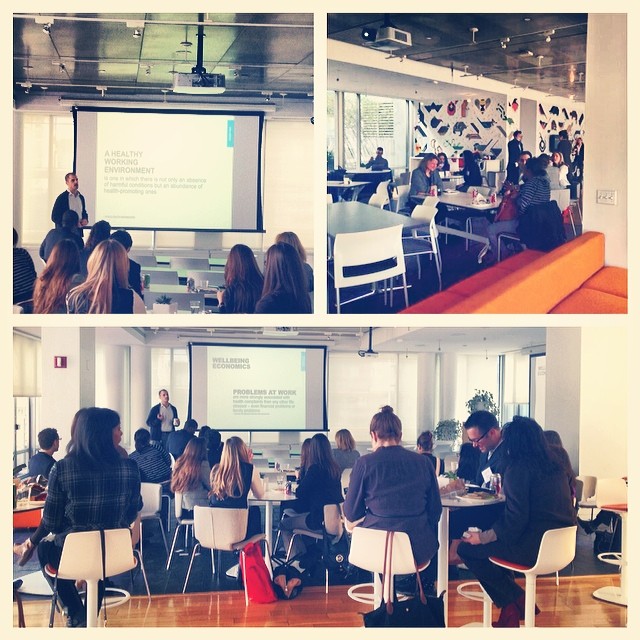
Leading Women Executives Tell Their Success Stories at Women's SIG Event
CoreNet NYC hosted "Positioning for Success in an Unpredictable World" on Tuesday, February 11, 2014 at Skadden Arps. Ellen Albert, Executive Vice President at Viacom, moderated a panel of leading women executives that included Beth Barton, Facilities Engineer Senior Associate at the Federal Reserve Bank; Donna Clark, Senior Vice President at Time Inc.; and Barbara Rooney, Senior Business Leader at Mastercard.
During this sold-out event, panelists examined how to characterize professional success. Through a dynamic discussion, each of these industry veterans shared lessons-learned and best practices in carving a career path, helping define expectations and outcomes and developing professional goals and action plans.
Offering insight on her unique path to success, Ms. Rooney stated “There is one thing you have to be mindful of in your career— to be strategic. Promote yourself; take credit for your accomplishments. Self promote.” Emphasizing the importance of mentorship, Ms. Clark advised “listen to the people who know you best.” Ms. Barton seconded this, explaining “there is a real support system that is real estate.”
Photo by Kelley Douglass, KI
Big Data and its Implications
on Real Estate Development
CoreNet NYC hosted "Just How Big is 'Big' Data?" on Wednesday, January 22, 2014 at AppNexus. Chris Zlocki, Executive Managing Director of Colliers International, moderated a panel that included Venkat Nagaswamy, Co-Founder and Chief Executive Officer of Mimir Data, Andy Howells, Head of Workplace Consultancy of Condeco, and Ron Dembo, Founder and CEO of Zerofootprint Software.
Significance of Big Data for Commercial Real Estate
Panelists explored how new analytics and technology are being used to understand behavior, improve operations, manage risk, support innovation and alter workplace strategy, and the implications that all of this has on the commercial real estate industry. Mr. Nagaswamy, Mr. Howells and Mr. Dembo developed the following findings:
• Up to a third of a building's workspace is being underutilized each day.
• Workspace occupancy measuring techniques and workspace utilization tools allow property managers to generate data sets, which are used to determine the effective use of buildings and resources.
• Digital alerts can change tenant behavior in Class A office buildings.
• Companies can utilize Big Data to streamline process, optimize output and maximize profit.
• Big Data can predict who should sit where and when in the workplace.
• Big Data will help forecast commercial real estate market trends and analytics.
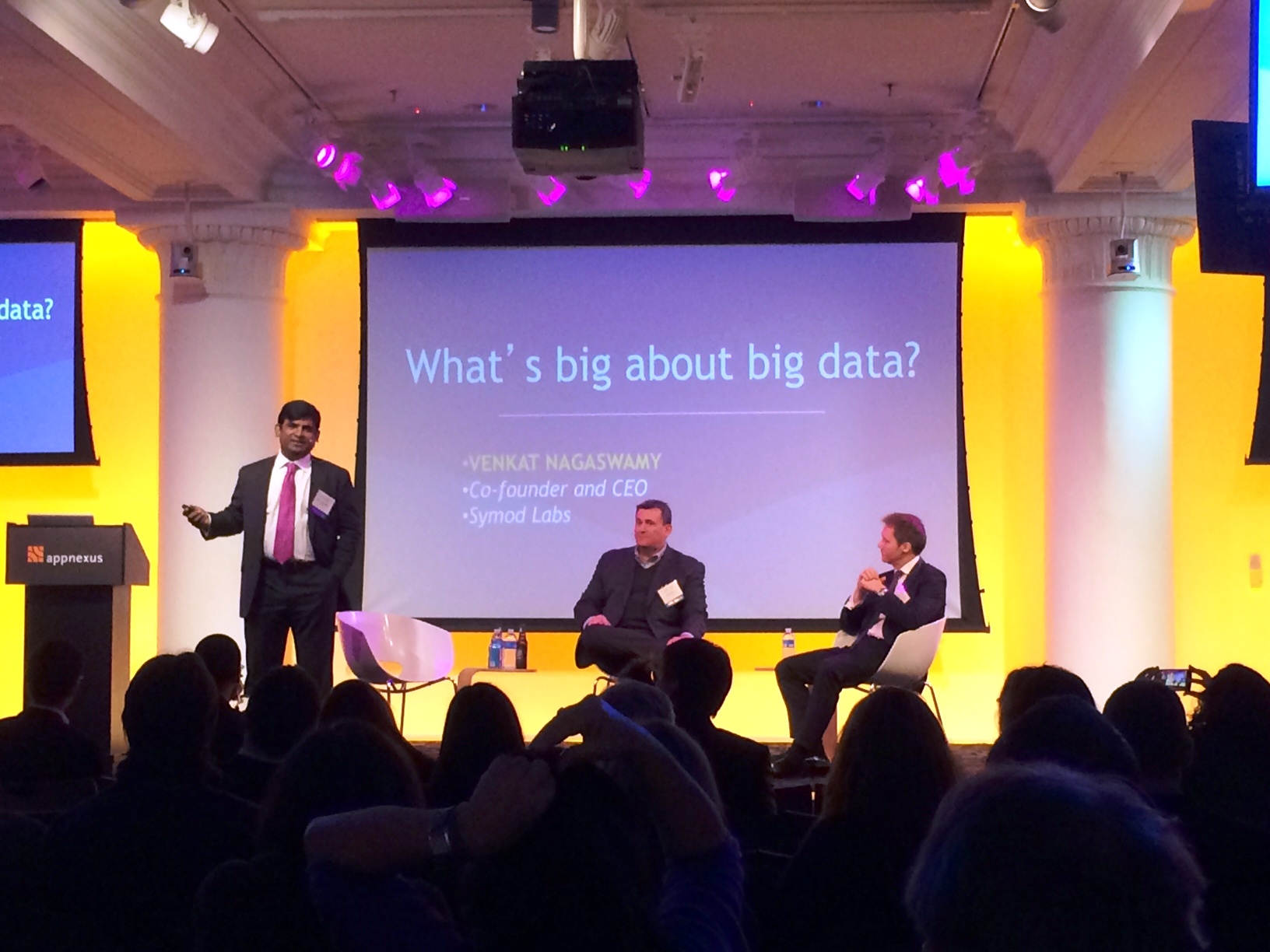
New Membership Survey Highlights Success
A real measurement of success in any organization is the satisfaction of its members. Respondents of CoreNet Global's recent membership survey report a 98% likelihood of renewing their membership; 97% indicate they would recommend CoreNet Global to a colleague; and 82% say they joined because of a colleague referral.
Our over 800 members may not be fully aware of all we offer as a professional association. Download a copy of our latest member benefits brochure now.
This Year’s Sold-Out New Year’s Party: Largest Event To Date
CoreNet NYC hosted its Annual New Year’s Party on Thursday, January 9, 2014. This year’s event was held at the Mandarin Oriental in New York City, a larger venue that could accommodate the record attendance.
Over 250 CoreNet NYC members and guests from the corporate real estate industry gathered to celebrate the start of the New Year. While looking to the year ahead, the organization hopes to continue its momentum in 2014 after being recognized as the 2013 CoreNet Global Chapter of the Year.

Check out more photos on Facebook.
CoreNet NYC Hosts Exclusive Tour Of The National 9-11 Museum and Memorial
On Wednesday, December 11, 2013, CoreNet Global New York City Chapter members attended “A Private Tour: 9/11 Museum and Memorial” at 4 World Trade Center. This CoreNet Workshop featured a private hard hat construction tour of the Memorial site with James Connors, Executive Vice President of Operations of the National September 11 Memorial and Museum. Mr. Connors provided insight on the construction and completion of the Memorial’s twin reflecting pools, which feature the largest manmade waterfalls in North America, and the Museum’s 110,000 square foot exhibit space. “September 11th is the largest collective event in history – the museum is meant to bring you back to that day,” he explained.
Following the guided tour through the site, members were give exclusive access to explore the Memorial and Museum, examining the implication September 11 had on America, New York and the City’s famous skyline.

Member Sarah Currie-Halpern and VVA Host Annual Toy Drive
CoreNet NYC Member Sarah Currie-Halpern and VVA project managers & consultants hosted their annual HELP USA Toy Drive Benefit on November 20, 2013. They collected toys and funds for the City's homeless families. Sarah's contribution to the community was featured in New York Real Estate Journal, read the full article here.
CoreNet Workshop: How to Leverage LinkedIn to Build Your Brand
On October 30, 2013, CoreNet NYC hosted a workshop entitled: How to Leverage LinkedIn to Build Your Brand. This exciting workshop aimed to provide focused training and insights that fosters personal and professional growth for CoreNet members. For more information on LinkedIn strategies, click on the link below to download the presentation or view a supplemental video that Jason Seiden, the workshop leader, created exclusively for CoreNet.
September/October Issue of The Leader Now Available
 CoreNet NYC Members have exclusive access to CoreNet Global's The Leader, a bimonthly professional journal and your best source for industry news, trends, developments and analysis. As a direct avenue to our member base of corporate real estate executives, representing the elite of the industry, this issue projects future trends in commercial real estate, the role of strategy, the value of human capital and consumerization.
Women’s SIG Hosts An Interactive Discussion On Professional Development
On October 8, 2013, CoreNet Women's SIG hosted Beth Weissenberger, Co-Founder/Partner of The Handel Group and renown radio personality, for a presentation on personal and professional development. Ms. Weissenberger discussed the importance of proactively guiding professional goals, while recognizing personal achievements and challenges. The audience was asked to draw examples from their personal and professional lives, creating a lively and interactive discussion.
Learn How To Leverage LinkedIn To Build Your Brand
As social media revolutionizes the way we connect with one another, knowing how to leverage all platforms is essential. LinkedIn is a unique tool that enables users to build their professional network while establishing a personal brand. Please join CoreNet NYC and Jason Seiden, Founder and CEO of AJAX Workforce Marketing and an approved partner of LinkedIn, for an exclusive members-only opportunity to discover and elevate your market value through the power of social media.
|
by Ashley Rigby, Education Specialist, Herman Miller, Inc.
|
|
by Jill Zunshine, Corporate Real Estate, Procurement, Supply Chain, and Operations Executive
|
|
by Jill Zunshine, Corporate Real Estate, Procurement, Supply Chain, and Operations Executive
|
|
by Jill Zunshine, Corporate Real Estate, Procurement, Supply Chain, and Operations Executive
|
|
by Jill Zunshine, Corporate Real Estate, Procurement, Supply Chain, and Operations Executive
|
|
by Jill Zunshine, Corporate Real Estate, Procurement, Supply Chain, and Operations Executive
|
|
by Jill Zunshine, Corporate Real Estate, Procurement, Supply Chain, and Operations Executive
|
|
By Sonya Verny, BDO, USA LLP and Carlie Hozza, Innovant, Newsletter Committee Members |